To figure out if a Rolex is the real deal, you need to trust your senses. Three things almost never lie: the reassuring weight from solid precious metals, the flawless sweep of the second hand, and the impeccable finishing on every single surface.
Counterfeiters have a nightmare trying to get these right, making them your best first line of defence against a fake.
Your Essential Rolex Authentication Checklist
Before you part with your hard-earned money, it pays to have a mental checklist ready. The world of pre-owned luxury watches is exciting, but it’s also teeming with incredibly convincing fakes, often called ‘super-clones’.
These aren’t the cheap knock-offs of the past. Today’s high-quality fakes can mimic a genuine Rolex so well that a quick glance just won’t cut it anymore. The secret to buying with confidence isn’t about spotting one big flaw; it’s about confirming that the sum of all the tiny, perfect details adds up.
From the precise 2.5x magnification of the Cyclops lens to the crisp, perfectly aligned engravings on the inner bezel ring (the rehaut), every element has to be flawless. A genuine Rolex feels solid and balanced on the wrist—a direct result of its 904L steel or precious metal construction. Fakes often feel surprisingly light or just don’t sit right.
The Small Details Tell the Biggest Story
The real challenge for buyers today is that counterfeiters are getting much better at copying the obvious stuff. That’s exactly why your inspection needs to go deeper. You have to scrutinise the little things that reveal true craftsmanship—or a total lack of it.
Think of these points as your foundation for a solid check:
- The Second Hand Sweep: A real Rolex is powered by a mechanical movement, which makes the second hand glide smoothly around the dial. A jerky, ticking motion is a dead giveaway of a cheap quartz movement used in most fakes.
- Text and Engravings: Look closely at the dial. Every letter in “Oyster Perpetual” or the model name should be perfectly crisp and look slightly raised. Engravings on the case and bracelet should be deep, sharp, and clean—not faint or fuzzy.
- The Winding Crown: When you unscrew the crown, it should feel silky smooth and precise. If it feels gritty, sandy, or loose, that’s a massive red flag.
Ultimately, the most reliable way to guarantee you’re buying an authentic timepiece is to purchase it from a reputable source. A trusted dealer’s expertise is your final, most important layer of security, removing any shred of doubt from the equation.
Knowing where to find a verified watch is just as important as knowing what to look for. For more on this, our complete guide on where to buy a Rolex watch offers practical advice to help you make a secure purchase.
A Guide to Visual Inspection Details
A genuine Rolex is a masterpiece of micro-engineering, a world where absolute perfection is the only standard. It’s in the tiniest, almost invisible details that you find the true craftsmanship, and it’s these exact details that counterfeiters just can’t get right. Learning how to check if a Rolex is real begins with training your eye and knowing precisely where to focus.
The first place to look is always the dial. On a real Rolex, the text—whether it’s the model name like “Submariner” or the classic “Oyster Perpetual”—is flawless. The lettering should be crisp with clean edges and feel slightly raised, almost like a 3D print. On fakes, you’ll often find the text looks flat, fuzzy, or has sloppy spacing.
Next, get a close look at the hands. Genuine Rolex hands are perfectly finished with sharp, polished edges and luminous material that’s applied without a single flaw. Under magnification, you shouldn’t see any rough spots, dust, or imperfections. The iconic Mercedes hour hand on a Submariner, for instance, must be perfectly proportioned and symmetrical.
Examining the Rehaut and Crystal
The rehaut is the inner metal ring sitting between the dial and the crystal. On modern Rolex models, this surface is engraved with “ROLEXROLEXROLEX” all the way around, finishing with a tiny laser-etched crown logo that lines up perfectly with the 12 o’clock marker.
This engraving is incredibly precise. The letters should be sharp, deep, and perfectly aligned with the minute markers on the dial. Fakes often stumble here, with engravings that are too shallow, misaligned, or have a rough, almost sandy texture. It’s a subtle but powerful giveaway.
Another critical check is the sapphire crystal itself. Since the early 2000s, Rolex has included a minuscule, laser-etched coronet (crown logo) at the 6 o’clock position. This is incredibly difficult to spot with the naked eye; you’ll usually need to tilt the watch in the light or use a jeweller’s loupe. Fakes that try to copy this detail usually make the logo too big, too obvious, or poorly etched.
Expert Tip: Professional dealers in London and East Anglia routinely use 10x loupes to inspect the laser-etched Rolex coronet at 6 o’clock on the sapphire crystal, a feature that has been widely used on modern models since the early 2000s and is still poorly copied on many fakes. They also weigh watches to the gram, as high-grade counterfeits often deviate by 5–15 grams from known factory specs due to cheaper steel or hollow links. In practice, authenticating in the UK now often combines these hands-on checks with movement verification, because genuine Rolex calibres typically run within −2/+2 seconds per day under the brand’s Superlative Chronometer standard, a performance level most counterfeits sold into the UK fail to match consistently. Read more expert insights about how to avoid being scammed on Kettle Club.
The Cyclops Lens Demystified
The Cyclops lens over the date is one of Rolex’s most distinctive features—and a very common failure point for fakes. A genuine Cyclops magnifies the date by exactly 2.5 times, making it pop and fill the entire window.
This powerful magnification is surprisingly difficult to replicate. Counterfeit versions typically only manage about 1.5x magnification, which leaves the date looking small, flat, or off-centre. The lens on a real Rolex also has an anti-reflective coating, so you shouldn’t see excessive glare. If you run your finger over it, it should feel like a subtle, smooth bump, perfectly integrated into the crystal.
The simple flowchart below illustrates the three foundational checks: weight, the sweep of the second hand, and the overall finish.
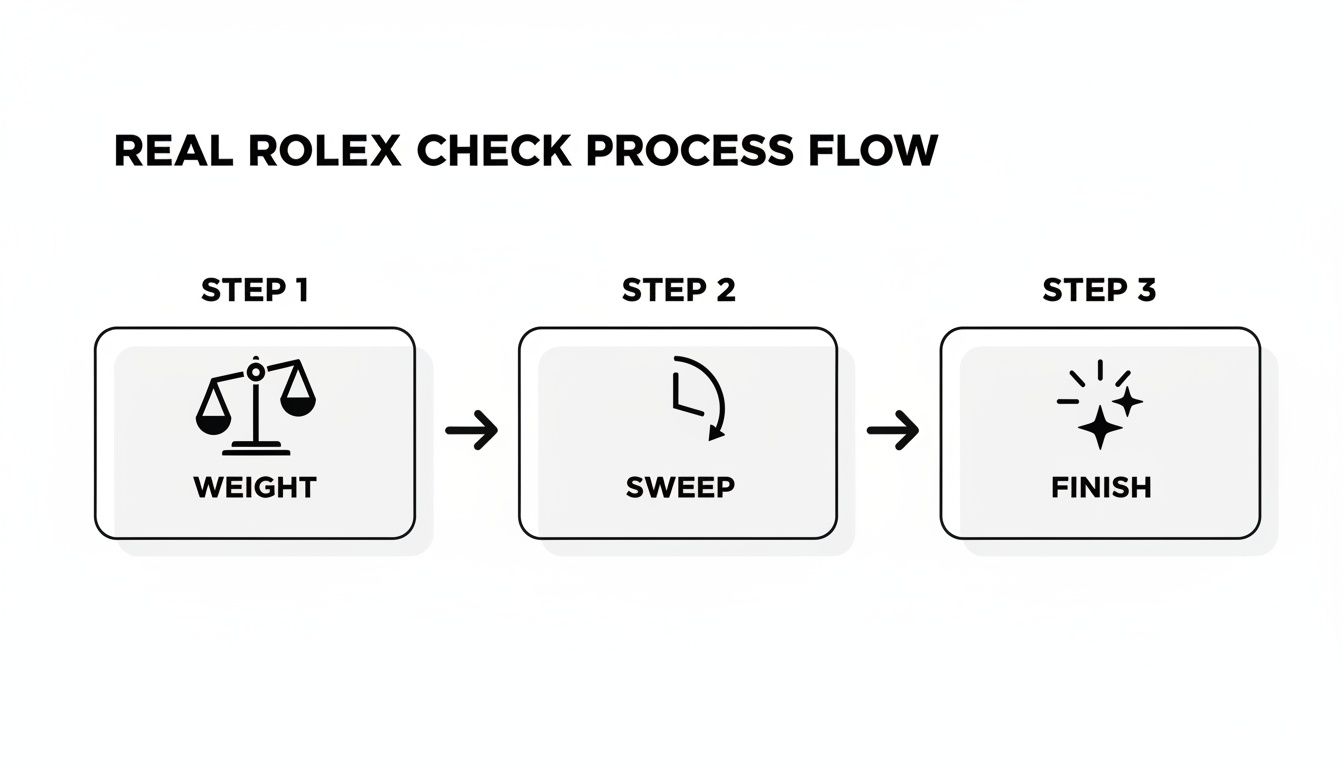
This visual guide reinforces that authenticity is confirmed through a combination of tactile feel, mechanical observation, and detailed visual scrutiny.
Checking the Bezel and Winding Crown
How a watch feels and sounds is just as important as how it looks. The bezel on a Rolex sports model like a Submariner or GMT-Master II is a masterclass in functional engineering. Turning it should produce a series of crisp, solid clicks with absolutely no backward play or looseness.
For example, a modern Submariner bezel has 120 clicks for a full rotation. Each click should feel and sound identical. Fakes often have bezels that feel gritty, are too stiff to turn, or make a hollow, cheap sound. They might also have fewer clicks or noticeable wiggle room between each position.
Finally, get a feel for the winding crown. A genuine Triplock or Twinlock crown unscrews with a buttery-smooth action. When you pull it out to set the time, the hands should move precisely without any shuddering or lag. Winding the watch should offer a smooth, consistent resistance, not a rough, grinding sensation.
These tactile checks give you immediate feedback. Rolex invests an incredible amount of effort into making every interaction with their watches feel premium and precise—a quality that is almost impossible to replicate on a budget.
Analysing the Weight, Finishing and Lume
Beyond the purely visual checks, a genuine Rolex communicates its authenticity through something much more primal: touch and feel. How a watch feels in your hand and on your wrist is often just as revealing as any detail you could ever spot through a jeweller’s loupe. While counterfeiters get better at mimicking appearances, replicating the substantial, perfectly balanced presence of a watch crafted from precious materials is another challenge entirely.
This tactile feedback is one of your most powerful tools. It’s an immediate, intuitive test that can often expose a fake long before you even start scrutinising the dial.
Feel the Substance and Weight
A real Rolex has a reassuring heft to it. The brand exclusively uses 904L steel, a highly corrosion-resistant and polishable alloy that is noticeably denser and heavier than the cheaper 316L steel commonly found in replicas. Of course, gold and platinum models feel even more substantial.
When you hold the watch, that weight should feel solid and evenly distributed. Counterfeit models, especially older or lower-grade ones, often use plated base metals or hollow bracelet links, making them feel flimsy, light, or just poorly balanced in comparison.
Take a modern steel Submariner, for example. It should feel like a solid block of beautifully machined metal, not a collection of loosely connected, rattly parts. If it feels surprisingly light, that’s a massive red flag.
The Art of Flawless Finishing
Rolex is legendary for its finishing, and this is an area where fakes consistently fall short. Run your fingers along the case, the bracelet, and the clasp. Every single surface, edge, and corner should feel perfectly smooth and expertly machined.
Pay close attention to the transition between brushed and polished surfaces. On a genuine Rolex, the line separating these two finishes is razor-sharp and absolutely perfect. You simply won’t find any blurry edges or signs of sloppy, rushed polishing.
Key areas to inspect for finishing quality include:
- Between the Lugs: This area, where the bracelet meets the case, should be just as immaculately finished as the more visible parts. Fakers often skip this.
- Crown Guards: The edges should be sharp yet smooth to the touch. There should be no rough or unfinished feeling whatsoever.
- Clasp Interior: Even the hidden parts of the clasp are finished to an incredibly high standard on a real Rolex. Fakes often leave these areas rough and unpolished to save on costs.
A genuine Rolex is designed to be perfect from every angle, inside and out. If you find rough edges, uneven polishing, or sharp corners that dig into your skin, you are almost certainly looking at a counterfeit.
The level of detail is simply meticulous. Even the tiny teeth on a bezel edge or the fluting on a Datejust bezel will be perfectly uniform and crisp. It’s this obsessive, expensive attention to detail that is incredibly difficult for forgers to replicate.
Testing the Luminous Glow
The luminous material, or “lume,” on the hands and hour markers is another critical checkpoint. Rolex has used two main types of lume in its modern history, and checking the colour and performance is a key indicator of authenticity.
First, you’ll need to “charge” the lume. Expose the watch dial to a bright light source (your phone’s torch works perfectly) for about 30 seconds. Then, take it into a dark room and observe the glow. A real Rolex will emit a powerful, bright, and long-lasting glow.
The colour of that glow is crucial:
- Chromalight: Used on most modern sports models since around 2008, this lume glows a distinct and vibrant blue.
- Super-LumiNova: The material used before Chromalight, this glows green.
If you’re looking at a watch that is supposed to have blue Chromalight but instead glows a weak, patchy green, that’s an immediate sign of a fake. The application of the lume itself should also be flawless—contained neatly within the marker boundaries with no smudges or overflow. The glow should be perfectly even across all markers and hands, without any dim spots.
Getting to Grips with the Movement and Caseback
While everything you can see on the outside tells a story, the heart of a Rolex—its mechanical movement—is the ultimate proof of its authenticity. This is where the counterfeiters just can’t keep up. We would never recommend you try opening a caseback yourself, but understanding what’s ticking away inside is a massive part of learning how to spot a real Rolex.
The first clue you can get without any tools is the famous sweep of the second hand. A genuine Rolex runs on a high-beat automatic movement, which means its tiny balance wheel oscillates incredibly fast—usually eight times every second. This gives the second hand a smooth, almost liquid glide around the dial, not a clumsy, jerky tick for each second.
Most fakes, on the other hand, use cheap automatic movements or, more often than not, a quartz (battery-powered) mechanism. This is what causes that obvious, stuttering “tick-tock” motion. If you see the second hand jumping from one second to the next, you’re almost certainly looking at a fake.
The Plain Truth About the Caseback
One of the biggest myths in the Rolex world surrounds the caseback. With only a handful of exceptions (like some very rare vintage pieces or the see-through caseback on the platinum Daytona), a genuine Rolex caseback is completely plain. It’s a simple, solid piece of metal, usually with a fine brushed or polished finish, and that’s it.
This is a classic mistake counterfeiters make, because they assume a luxury watch needs flashy engravings everywhere. Be very suspicious if you see a watch with:
- An exhibition or “see-through” caseback: Rolex doesn’t show off its movements this way. A glass caseback is a huge red flag.
- Engraved logos or text: If you see the Rolex coronet, the model name, or serial numbers plastered on the outside of the caseback, it’s almost guaranteed to be a fake.
A genuine Rolex whispers its quality; it doesn’t shout it from the back of the case. The understated, solid steel caseback is a hallmark of the brand’s functional, tool-watch heritage. Any attempt at flashy decoration on the caseback should be treated with extreme suspicion.
Why a Professional Look Inside is Non-Negotiable
Because the movement is the soul of the watch, having it professionally checked is the final, essential step for 100% certainty. A trusted watchmaker can safely open the caseback with specialised tools to get a proper look at the calibre inside.
What they’ll find in a genuine Rolex is a work of art. The movement will be immaculately finished, often with distinctive purple or red reversing wheels and crisp engravings of the calibre number and “Rolex Geneva” branding. Counterfeit movements, even the so-called “super-clones,” will always show rough finishing, mismatched colours, or incorrect markings under expert magnification.
This professional check doesn’t just confirm its authenticity; it also tells you about the health of your investment. It provides complete peace of mind, and when you’re spending this kind of money, that’s exactly what you need.
Decoding Serial Numbers and Paperwork
A Rolex’s physical features only tell you half the story. The other half—its unique identity and history—is locked away in its serial numbers and the paperwork that comes with it. Think of these documents as the watch’s passport; they create a verifiable trail that’s crucial for confirming its legitimacy.
Getting this part right is one of the most powerful ways to check if a Rolex is real. While a convincing fake might look the part, replicating the precise, matching documentation is where many forgeries fall apart. Every genuine Rolex leaves the factory with its own unique identity, and your job is to make sure the watch in your hand matches the story on the paper.
Where to Find and Verify Serial Numbers
Every Rolex has two vital numbers engraved on its case: the reference number (which tells you the model) and the serial number (which is unique to that specific watch). Knowing where to find them and what you’re looking for is essential.
On older Rolex models, which is generally anything before 2007, you’ll need to pop the bracelet off to find these engravings.
- The reference number is found between the lugs at the 12 o’clock position.
- The serial number is engraved between the lugs at the 6 o’clock position.
For modern Rolex watches made since around 2007, the serial number has been moved to a much more visible spot: the inner bezel ring, also known as the rehaut. You’ll see it engraved around the dial, finishing at the 6 o’clock mark. The reference number is still tucked away between the lugs at 12 o’clock.
The quality of the engraving itself is a huge giveaway. A genuine Rolex has these numbers etched with diamond-tipped tools, creating deep, sharp lines that catch the light perfectly. Fakes often use a crude acid etching, which results in shallow, fuzzy, or “sandy” looking numbers that are faint and poorly defined.
A mismatched serial number or a sloppy engraving is an immediate, non-negotiable red flag. It’s like a passport with a blurry photo and a misspelled name—it just doesn’t add up.
Cross-Referencing Serial Numbers and Production Dates
Once you’ve found the serial number, you can use it to get a rough idea of the watch’s production year using charts widely available online. This is a critical step because the production date has to make sense with the watch’s features. For instance, a serial number suggesting a 1995 production year on a watch with a blue Chromalight display (which was introduced around 2008) is an impossible combination.
This cross-referencing helps you build a consistent timeline for the watch. For UK buyers, this paper trail is more important than ever, especially since Rolex introduced its Certified Pre-Owned (CPO) programme. One of the best authentication tools is the serial-number trail and service history. You must check the serial number against dates on UK service receipts or dealer invoices; mismatched years are a huge red flag that British pre-owned specialists see all too often.
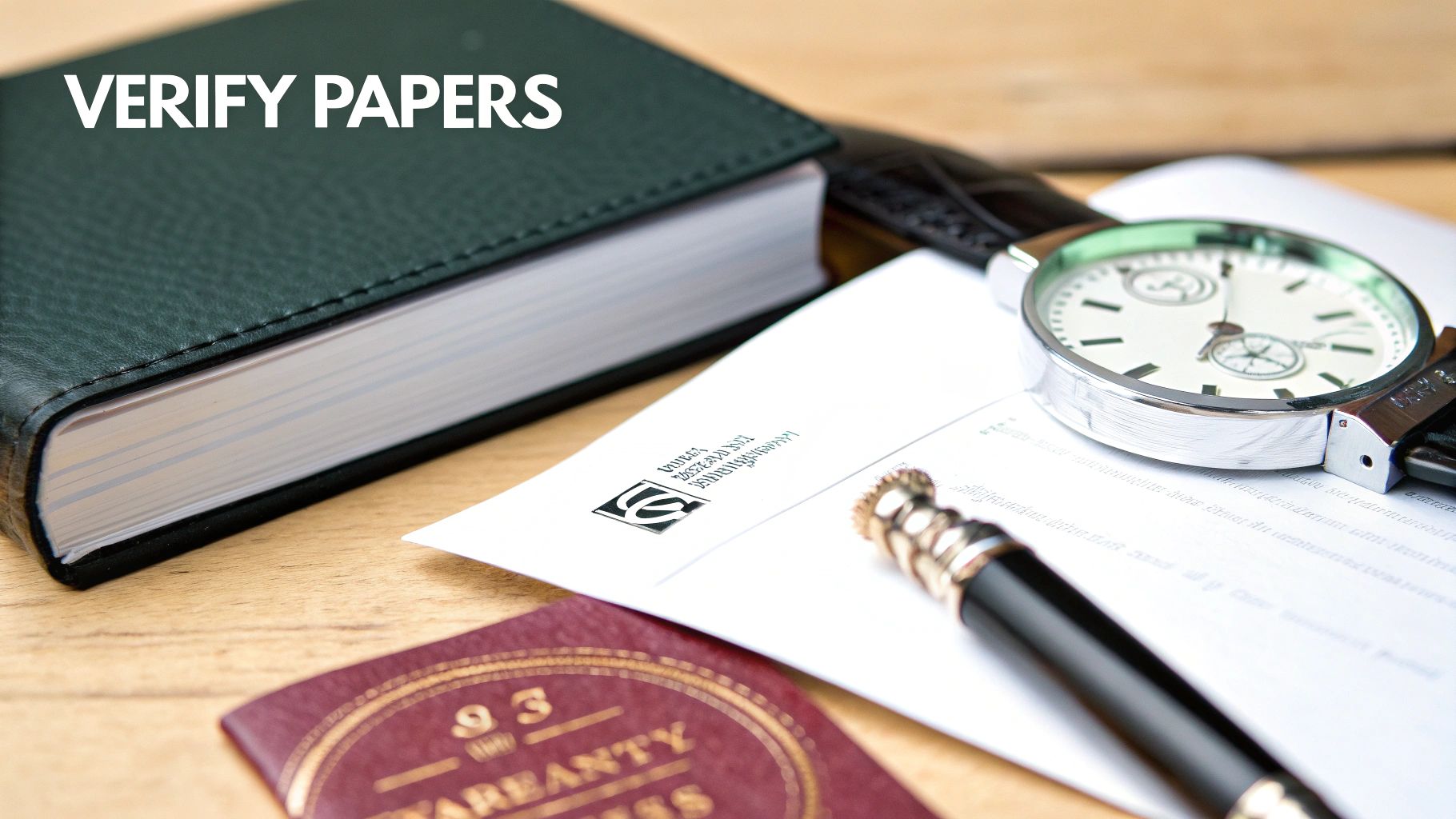
Scrutinising the Warranty Card and Papers
A “full set” Rolex will come with its original box and papers, and the most important piece of paper is the warranty card. The details on this card must perfectly match the watch.
Here’s your checklist:
- Serial Number: The serial printed on the card has to be an exact match to the one engraved on the watch’s rehaut or between its lugs. There’s absolutely no room for error here.
- Reference Number: The model number on the card must also correspond to the watch model.
- Authorised Dealer Stamp: The card should be stamped or printed with the name and location of the official Authorised Dealer (AD) who first sold the watch.
- Date of Purchase: This should be filled in, giving you a starting point for the watch’s history.
Modern Rolex warranty cards (from 2015 onwards) are green plastic cards with an NFC chip inside, whereas older ones were paper certificates or different styles of plastic cards. Counterfeit papers often have blurry text, wrong fonts, or even spelling mistakes. A genuine set just feels premium, with crisp printing and high-quality materials. If you’re thinking of selling your own watch, knowing what paperwork buyers expect is vital; you can learn more in our complete guide on how to sell a Rolex.
A full service history from Rolex or a certified watchmaker adds another powerful layer of security. It creates an unbroken chain of ownership and maintenance linked directly to that unique serial number. A clean paper trail isn’t just a nice bonus—it’s one of your strongest defences against a sophisticated fake.
When to Trust Professional Authentication
Even with the most detailed checklist, there comes a point where a DIY inspection just isn’t enough to be certain you’re holding a real Rolex. It’s a tough pill to swallow, but the rise of so-called “super-clones”—counterfeits so frighteningly accurate they can fool even seasoned collectors at first glance—means a professional eye is sometimes non-negotiable.
Your own visual checks are a brilliant first line of defence. But they have their limits.
Without specialised tools, it’s impossible to verify the single most critical component: the movement. An expert has the right equipment and years of experience to go much deeper. They can safely open the caseback to confirm the calibre number, inspect the finishing on hidden components, and guarantee everything is genuine Rolex craftsmanship. This is the ultimate failsafe against even the most convincing fakes.
The Tools of the Trade
Expert authenticators don’t just rely on a magnifying loupe. They use sophisticated equipment to test aspects of a watch you simply can’t assess on your own. This is where professional verification stops being a cost and becomes an insurance policy for your investment.
Here are a few key tools and what they do:
- Timegrapher: This device is like an ECG for a watch. It measures the movement’s accuracy, beat error, and amplitude, giving a clear health check. A genuine Rolex calibre must perform within the brand’s incredibly strict -2/+2 seconds per day chronometer standards—a feat most clones can’t consistently replicate.
- Pressure Tester: This machine checks the watch’s water resistance by putting the case under controlled air pressure. It’s the only way to confirm the integrity of the seals and gaskets, proving the watch is as robust as it claims to be.
Professional verification provides the one thing a self-check never can: absolute certainty. When you’re investing thousands, that peace of mind is priceless, transforming a potentially risky purchase into a confident acquisition of horological history.
This reality has shaped how people buy watches here in the UK. Savvy buyers now look for dealers who advertise multi-point checks as standard. These typically include dial originality checks, bracelet and clasp reference matching, a pressure test for water resistance, and verification that the lume type is correct for the watch’s production year.
Ultimately, the smartest move is to partner with an expert from the very beginning. A trustworthy dealer performs these rigorous checks on every single timepiece before it’s ever offered for sale. To make sure you’re working with a reputable specialist, have a look at our guide on how to find a luxury watch dealer you can trust.
Common Questions About Rolex Authenticity
Even with a detailed checklist in hand, a few questions always seem to pop up when you’re trying to verify a Rolex. Getting straight answers to these is key to building your confidence and steering clear of the most common counterfeit traps.
Can a Real Rolex Have a Ticking Sound?
A genuine Rolex movement is incredibly smooth, but it’s not completely silent. If you press the watch right up to your ear, you should hear a series of extremely fast, faint “tings” – almost like a high-speed metallic purr. That’s the sound of the balance wheel oscillating, typically at a rate of eight times per second.
What you absolutely should not hear is a loud, slow “tick-tock”. That’s the hallmark of a cheap quartz movement. The real giveaway, though, is visual: the famous sweep of a Rolex seconds hand must glide effortlessly around the dial, not stutter from one second to the next.
Is It Safe to Buy a Rolex Without Box and Papers?
It certainly can be, but you have to be far more cautious and rely entirely on a trusted, reputable seller. A “naked” watch isn’t automatically fake; countless genuine vintage pieces have simply become separated from their original sets over decades of ownership.
If you’re looking at a watch without its original documentation, it’s absolutely vital to buy from a dealer who provides their own solid guarantee of authenticity and a proper warranty.
A trustworthy seller authenticates every single watch that passes through their hands, regardless of paperwork. The price should also be fairly adjusted to reflect the missing items.
What Is the Biggest Red Flag for a Fake Rolex?
While there are many tell-tale signs, a poorly executed date magnification—the “Cyclops” lens—is one of the most immediate and obvious giveaways. For whatever reason, counterfeiters really struggle to replicate the crisp 2.5x magnification that a genuine Cyclops provides.
If the date looks small, blurry, off-centre, or just a bit flat through the lens, it’s a massive warning sign. Another huge red flag is, of course, a price that seems too good to be true. It almost always is.
At Motion Watches, we provide the peace of mind that comes from expert, multi-point authentication on every timepiece. Explore our fully verified collection and invest with absolute confidence at https://motionwatchesuk.com.