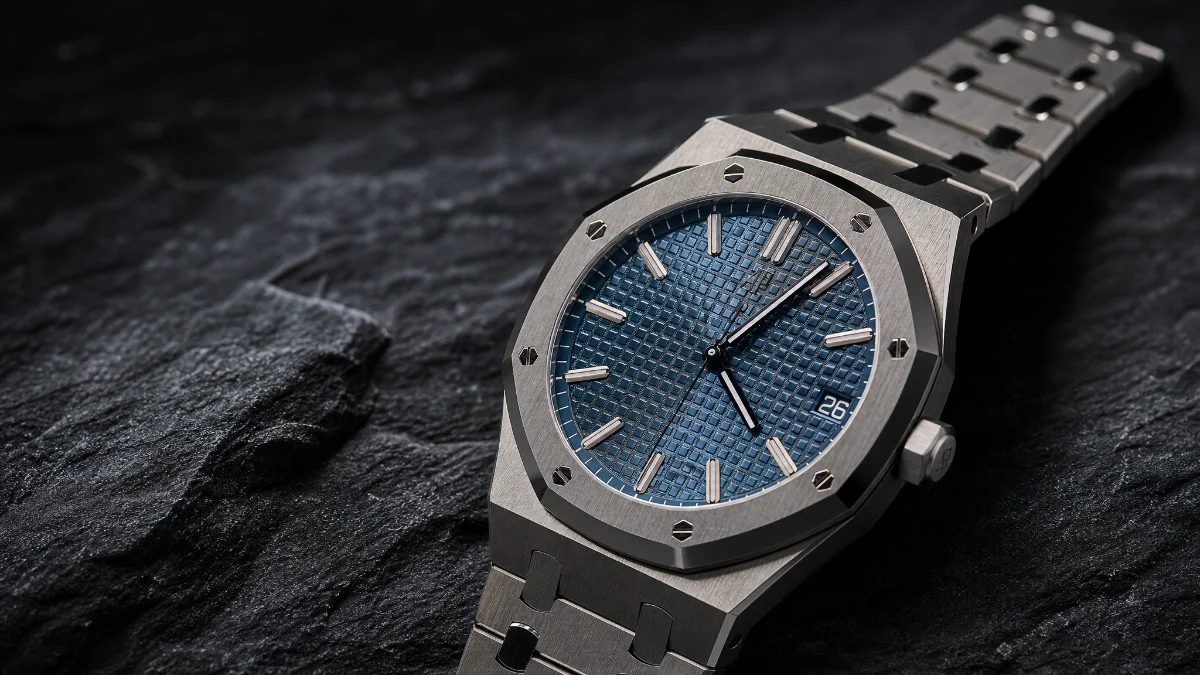
Few watches get asked about as an “investment” as often as the Audemars Piguet Royal Oak. It’s a fair question — steel Royal Oaks have traded well above retail for years, and the brand’s own scarcity strategy is central to how it sells the watch in the first place. But “is it a good investment” deserves a more honest answer than the marketing version, so here’s what the numbers and the buying process actually tell you.
What actually drives Royal Oak value
Audemars Piguet doesn’t compete with Rolex on volume — it deliberately doesn’t. Steel Royal Oaks are allocated through a fully AP-owned boutique network (there’s no multi-brand authorised dealer to shop around, unlike Rolex), with each boutique receiving only a handful of steel Royal Oaks a year to sell. Allocation isn’t a simple queue either: it runs on purchase history and relationship with a boutique, and a steel Royal Oak as someone’s very first AP purchase is genuinely unlikely without an established buying history first. Typical waits run anywhere from a few months to well over a year, and roughly half of buyers in recent surveys received their watch within three months — the other half waited considerably longer.
This is the single fact that explains almost everything about Royal Oak resale value: it isn’t really about the watch being rare in absolute terms, it’s about AP deliberately restricting who gets to buy one new, at what price, and when.
That scarcity is what pushes pre-owned and grey-market prices above retail for current steel references — buyers who don’t want to build a relationship with a boutique over months or years pay a premium to skip the process entirely.
The honest history: hype, correction, and where things stand now
The Royal Oak’s most extreme pricing came during the 2021-2022 luxury watch boom, when steel sports watches across Rolex, Patek Philippe and AP all traded at exceptional premiums over retail. That period was followed by a broad correction across the entire pre-owned luxury watch market from 2022 onwards, and Royal Oak pricing came down from those peaks along with everything else in the category — a pattern collectors should know about before assuming current premiums are permanent or guaranteed to keep climbing.
What’s held up better than the hype-driven premiums is the underlying scarcity fundamental: because AP still restricts supply deliberately, well-kept steel Royal Oaks in current or recently-discontinued references have generally retained meaningfully more of their value than most other luxury watches, even after the broader correction. The lesson isn’t “Royal Oaks only go up” — it’s that scarcity-driven value retention is real, but it isn’t the same thing as guaranteed appreciation, and prices can and do move in both directions.
Which references tend to hold value best
Not all Royal Oaks behave the same way in the secondary market. Broadly:
- Steel, time-only references (the core “Jumbo” 39mm and current 15500-series) are the most sought-after and typically command the strongest premiums and best long-term retention, precisely because they’re the hardest to get new.
- Steel chronographs sit a tier below time-only pieces for allocation difficulty, and pricing reflects that — still strong, generally a longer wait for a first-time buyer, but somewhat less pressure than the flagship time-only references.
- Royal Oak Offshore models are generally the most accessible point of entry into steel AP ownership, with shorter typical waits, which is reflected in comparatively gentler premiums.
- Precious metal and complicated references (perpetual calendars, tourbillons, skeleton pieces) behave more like traditional high-horology purchases — genuinely exceptional watchmaking, but pricing and resale are driven more by the complication and rarity of that specific reference than by the broad “Royal Oak” scarcity story.
Our current stock illustrates this spread well: from a steel Royal Oak Diver at the more accessible end, through core steel time-only and chronograph references, up to a Royal Oak Perpetual Calendar and a Skeleton reference at the top of the range — each with a genuinely different value story rather than one single “Royal Oak price.”
A real snapshot of how wide the range actually is
“How much is a Royal Oak worth” isn’t really one question, and our own stock at the time of writing makes that obvious. A steel Royal Oak Offshore sits at a genuinely different price point to a Royal Oak Perpetual Calendar or a Skeleton reference — not because one is “more Royal Oak” than the other, but because complication, materials and rarity within the range matter as much as the Royal Oak name itself. A buyer chasing the core steel time-only look and a buyer chasing serious high-horology complications are effectively shopping in two different markets that happen to share a case design and a bracelet.
This is worth understanding before you fixate on “the Royal Oak price” as a single number — the honest answer is always “which one, in what metal, with what complication,” and the value-retention story changes accordingly.
Why AP restricts supply in the first place
It’s worth understanding the business logic behind the waiting lists, because it explains why this isn’t likely to change. Audemars Piguet is a genuinely small manufacturer compared to Rolex — total annual production is a fraction of Rolex’s output — and the brand has made a deliberate strategic choice to keep it that way rather than scale up to meet demand. Restricting supply protects both the perceived exclusivity of the Royal Oak and the brand’s ability to sell it at boutique price without discounting, which in turn is exactly what supports pre-owned values. It’s a self-reinforcing system: scarcity supports price, and AP has no commercial incentive to loosen it.
How Royal Oak compares to Rolex and Patek Philippe as a purchase
All three brands use scarcity to different degrees, but the mechanics differ. Rolex sells through independent authorised dealers, so allocation varies dealer to dealer and a determined buyer has more doors to try. AP’s boutique-only model is more centralised and relationship-driven, which can feel more opaque but also means loyalty with a single boutique compounds over time. Patek Philippe sits at the most extreme end of scarcity and waiting-list difficulty for its steel sports references, generally exceeding both Rolex and AP. If you’re weighing these against each other purely as a value-retention question, our guide on whether Rolex watches are a good investment covers the Rolex side of this comparison in more depth.
Protecting the value once you own it
Whatever your reason for buying, a watch at these price points is worth insuring properly rather than assuming it’s covered under a standard home contents policy — many general policies cap single-item value well below what a Royal Oak is worth, or exclude watches from cover away from the home entirely. Keeping servicing documented, storing the box and papers safely, and getting an up-to-date valuation every few years all support both an accurate insurance policy and the watch’s resale value if you ever decide to sell.
What to check before buying pre-owned for value retention
- Full box and papers. This matters more for value retention on AP than almost any other brand — an incomplete set measurably affects resale on Royal Oaks specifically.
- Bracelet and case condition. The integrated bracelet is structurally part of the design’s value; stretched links or heavily polished case edges affect both look and resale more than on a simpler case shape.
- Service history. As with any high-value mechanical watch, documented servicing supports both authenticity and future resale.
- Independent authentication. Royal Oak’s fame and price point make it a genuine counterfeiting target — every watch we sell is independently authenticated before it goes anywhere near a customer.
- Realistic expectations. Buy a Royal Oak because you want to own and wear one. Treat any value retention as a possible bonus, not a guarantee — watch prices, like any collectible asset, can fall as well as rise, and nothing here should be read as financial advice.
Buying from Motion Watches
We currently hold a genuinely wide spread of Royal Oak references, from an accessible steel Diver through to a Perpetual Calendar and Skeleton reference at the top of the range — a useful illustration of just how differently individual references perform rather than one uniform “Royal Oak price.” Every watch we sell is independently authenticated, and we’re always happy to talk through which reference genuinely suits your budget and how you’ll wear it, rather than just what’s easiest to sell. Stock moves quickly in this range, so the best way to see exactly what’s available is to browse our current Audemars Piguet stock directly. If a specific reference isn’t currently with us, our watch sourcing service can look for it on your behalf.
Looking to sell a Royal Oak instead? We offer straightforward, no-obligation valuations based on current market conditions, not a lowball opening offer.
Do Audemars Piguet Royal Oaks go up in value?
Well-kept steel time-only references have generally retained value better than most watches thanks to deliberate scarcity, but prices moved down significantly from the 2021-2022 peak along with the rest of the luxury watch market. Value retention isn’t the same as guaranteed appreciation.
Why is there a waiting list for the Royal Oak?
AP deliberately limits how many steel Royal Oaks each of its own boutiques receives per year, and allocates them based on purchase history and relationship rather than a simple first-come queue.
Which Royal Oak holds its value best?
Steel, time-only references such as the 39mm Jumbo and current 15500-series generally command the strongest premiums and retention, since they’re the hardest AP references to obtain new.
Is buying pre-owned a good way to get a Royal Oak?
For most buyers, yes — it avoids months or years of building a boutique relationship with no guarantee of allocation. You’ll typically pay above the original retail price for current steel references, but you can own the watch immediately rather than waiting.
Does Motion Watches buy Royal Oaks too?
Yes. We buy and value Royal Oaks and other Audemars Piguet models directly, with a straightforward, no-obligation valuation process.