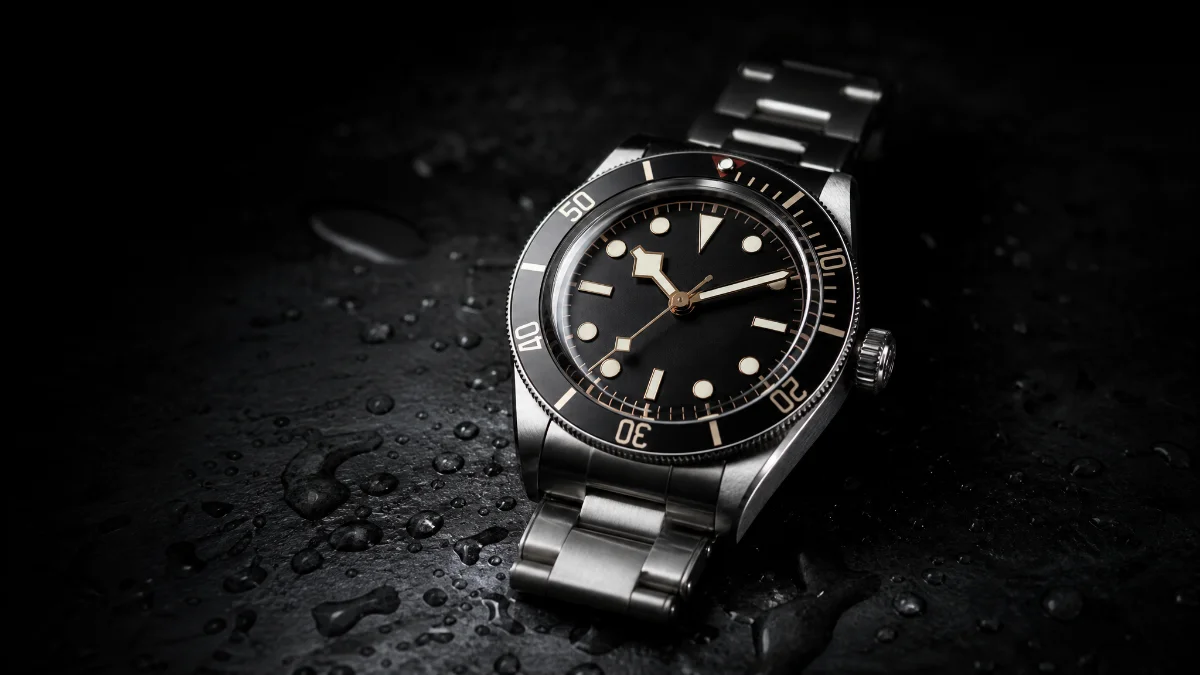
The Tudor Black Bay has done something very few watches manage: it built a genuine following in barely a decade. Since 2012 it has grown from a single vintage-inspired diver into a full family of references, and it’s now one of the most searched-for pre-owned watches we handle at Motion Watches. If you’re weighing one up, here’s what actually matters before you buy.
A short history of the Black Bay
Tudor launched the original Black Bay in 2012 as the Burgundy Heritage, reference 79220R. It borrowed details from three vintage Tudor Submariners — the 1954 ref. 7922, the 1958 ref. 7924, and the 1969 ref. 7016 — into a single 41mm case, and the result won the Revival prize at the Grand Prix d’Horlogerie de Genève that year. It also marked Tudor’s return to the US market after decades of only being sold internationally, a sign of how much weight the brand was putting behind it.
Early Black Bays ran on the workhorse ETA 2824 movement — reliable, but not something Tudor made itself. That changed in 2016 with the calibre MT5602, developed with movement partner Kenissi: a 70-hour power reserve against the ETA’s 38 hours, a silicon hairspring, and COSC chronometer certification. From here the Black Bay stopped being simply a stylish case around a bought-in movement and became a genuine in-house proposition.
The snowflake hands on every modern Black Bay are a direct nod to the watches Tudor built for the French Navy in the 1970s — one of the few details Tudor has never redesigned away.
Since then the range has diversified by size and purpose rather than just colourway: the 39mm Black Bay 58 arrived in 2018 (named for the 1958 ref. 7924 it echoes), the Black Bay GMT the same year, the exploration-focused Black Bay Pro in 2022, and the smaller 37mm Black Bay 54 — the most faithful to the original 1950s proportions — in 2023. From 2021 onwards, newer references have progressively moved to METAS Master Chronometer certification, a tougher standard than COSC alone, covering magnetic resistance and real-world accuracy as well as timekeeping.
What’s actually in the current line-up
“Black Bay” isn’t one watch, it’s a family, and the differences matter more than the shared name suggests:
| Model | Case size | Movement | Best for |
|---|---|---|---|
| Black Bay 54 | 37mm | MT5400, Master Chronometer | Smaller wrists, closest to the 1950s original |
| Black Bay 58 | 39mm | MT5400/5402, Master Chronometer | The all-rounder — the one most people mean by “Black Bay” |
| Black Bay GMT | 39mm | MT5652, true GMT | Travel, tracking a second time zone |
| Black Bay Pro | 39mm | MT5652, 24-hour bezel | An Explorer II-style alternative with GMT function |
| Black Bay Chrono | 41mm | Column-wheel chronograph | A sportier, dressier proposition |
New pricing across the current range spans roughly £2,500 to £10,000 depending on model, case material and complication, with the core steel models sitting toward the lower end of that band. Because Tudor doesn’t restrict supply the way Rolex does, most current Black Bay references are genuinely available at boutiques without a waiting list — which changes the pre-owned calculation completely, and it’s the single biggest thing to understand before you buy one second-hand.
Black Bay vs Rolex Submariner: how they actually compare
The comparison comes up constantly, and it’s a fair one to make since Tudor and Rolex share a parent company and, since 2016, a movement-manufacturing partner in Kenissi. But they’re not the same watch at different price points — they’re built for different buyers.
A Submariner is the more conservative, more universally recognised choice, with decades of unbroken production and a resale market propped up by genuine scarcity — you’ll typically pay above retail for a steel Submariner pre-owned, waiting list or not. A Black Bay 58 gives you a similar dive-watch silhouette, a genuinely capable in-house chronometer movement, and — because Tudor doesn’t ration supply the same way — a pre-owned market that behaves like a normal luxury good rather than an appreciating asset you have to queue for. Neither is the objectively “better” watch; the Submariner buys you brand weight and resale security, the Black Bay buys you more watch for less outlay and the flexibility to actually choose your reference rather than take whatever a boutique happens to allocate you.
Our honest take: if you want a dive watch to wear and enjoy without thinking about resale, the Black Bay 58 is very hard to beat for the money. If part of the appeal is the investment case and long-term liquidity, the Submariner still has the edge — see our separate guide on whether Rolex watches are a good investment for more on that side of things.
Why pre-owned Black Bay pricing works differently to Rolex or Patek
With a Rolex Submariner or a Patek Nautilus, boutique scarcity pushes pre-owned prices above retail. Tudor doesn’t have that problem in the same way. Because current Black Bay references are usually just orderable, pre-owned examples of current or recent models often trade close to — or even below — their original retail price, especially once a newer generation has been announced. Where pre-owned genuinely earns its premium is on discontinued colourways, limited editions, and older references with the last-generation bronze or “Harrods” special editions that Tudor no longer makes.
What that means practically: buying pre-owned isn’t primarily about beating a waiting list here, it’s about accessing a reference, colourway or bracelet configuration that isn’t sold new any more, at a fair market price, from a dealer who’s actually checked it over.
What to check before buying a pre-owned Black Bay
- Movement generation. Pre-2016 Black Bays run the ETA 2824, not Tudor’s own MT movement — still a good watch, but a different proposition to anything from 2016 onward, and worth knowing which you’re being offered.
- Bracelet type. Recent Black Bay 58 models come on a new five-link bracelet that’s a genuine ergonomics upgrade over the older three-link “rivet” style — check which one is fitted, as this affects both comfort and resale.
- Box, papers and service history. As with any pre-owned watch over £2,000, full paperwork and a documented service history support both authenticity and future resale value.
- Case and bezel condition. The aluminium bezel inserts on older Black Bays can fade or scratch more visibly than the ceramic used on current models — normal wear, but worth pricing in.
- Independent authentication. Counterfeiting has increased across the pre-owned watch market generally, Tudor included. Every watch we sell is independently authenticated before it goes anywhere near a customer.
Servicing and running costs
One thing buyers new to the brand sometimes overlook: a Black Bay needs the same ongoing care as any mechanical Swiss watch. Tudor recommends a full service roughly every 10 years for modern in-house movements, though real-world intervals depend on how the watch is worn and stored. A full service through an authorised centre typically runs to a few hundred pounds, more if parts need replacing — worth factoring into the true cost of ownership, particularly on an older pre-owned example where you don’t know the full service history. This is exactly why documented service records matter as much as the watch’s cosmetic condition when you’re comparing two otherwise similar listings.
Water resistance is also worth a mention: most modern Black Bay divers are rated to 200m, genuinely capable of swimming and snorkelling, but like any watch with a screw-down crown, the gaskets that maintain that rating degrade over time and are checked (and replaced if needed) as part of a proper service — not something to assume is still intact on a watch that hasn’t been serviced in a decade.
Buying from Motion Watches
We currently hold a genuine spread of Black Bay references in stock, from entry-level steel pieces through to five-figure limited runs — a useful illustration of how wide the pre-owned market for this collection really is. A few examples from current stock at the time of writing:
- A Black Bay 58 Burgundy, one of the collection’s most popular colourways on the 39mm case.
- A Black Bay 54 in Blue Lagoon, the smaller 37mm option for anyone finding the 58 sits slightly large.
- A Tudor Pelagos FXD in titanium, for buyers who want the toughness and lighter weight of Tudor’s more technical dive line rather than the vintage-styled Black Bay case.
- Several Black Bay Chrono references, including limited-run colourways, for anyone wanting the sportier chronograph version of the family.
Stock moves quickly in this range, so treat the above as a snapshot rather than a guarantee — the best way to see exactly what’s currently available is to browse our current Tudor stock directly. Every watch we sell is independently authenticated, and we’re always happy to talk through which reference actually suits how you’ll wear it before you commit, not just what’s easiest to sell. If nothing in stock is quite right, our watch sourcing service can also look for a specific reference or colourway on your behalf.
If you’re looking to sell a Black Bay rather than buy one, we offer straightforward valuations with no obligation — get in touch and we’ll give you an honest figure based on current market conditions, not a lowball opening offer.
Is the Tudor Black Bay a good first luxury watch?
It’s one of the most commonly recommended entry points into Swiss mechanical watches, thanks to a genuine in-house chronometer movement, real availability at boutiques, and a design that doesn’t date quickly. It sits below Rolex on price while sharing some manufacturing heritage with it.
Is there a waiting list for the Black Bay?
Generally no. Unlike steel sports Rolex references, most current Black Bay models can be ordered directly from a boutique without a long wait, which is exactly why pre-owned pricing behaves differently to Rolex.
What’s the difference between the Black Bay 58 and Black Bay 54?
The Black Bay 58 is 39mm and the more versatile, best-selling size. The Black Bay 54, introduced in 2023, is smaller at 37mm and more faithful to Tudor’s original 1950s dive watch proportions, suiting smaller wrists particularly well.
Does Tudor use the same movements as Rolex?
No. Tudor’s MT-series movements are developed with manufacturing partner Kenissi, a company in which Rolex has an ownership stake, so there’s a shared heritage, but the movements, cases and design language are entirely Tudor’s own.
How often does a Tudor Black Bay need servicing?
Tudor recommends a full service roughly every 10 years for its modern in-house movements, though this varies with how the watch is worn. Always ask for documented service history when buying pre-owned.
Does Motion Watches buy Black Bays too?
Yes. We buy and value Black Bays and other Tudor and Rolex models directly, with a straightforward, no-obligation valuation process.