Most watches earn their reputation from craftsmanship alone. The Omega Speedmaster earned part of its from NASA. If you’re thinking about buying one, that history matters less for bragging rights and more because it explains exactly why the watch still looks and works the way it does — and what you should actually be paying for.
How the Speedmaster became “the Moonwatch”
Omega launched the original Speedmaster in 1957 as a motorsport chronograph, reference CK2915. It wasn’t designed for space at all — that came later, and almost by accident. In 1965, NASA put a handful of chronographs from different brands through a brutal qualification programme: extreme heat and cold, vacuum, humidity, shock and vibration testing designed to simulate spaceflight conditions. The Speedmaster was the only one that survived intact, and NASA certified it “Flight-Qualified for all Manned Space Missions” that March.
Buzz Aldrin wore his Speedmaster on the lunar surface during the Apollo 11 moonwalk in July 1969 — Neil Armstrong left his behind in the lunar module as a backup timer. Either way, it’s the reason the Speedmaster is the watch most people picture when they hear “worn on the Moon.”
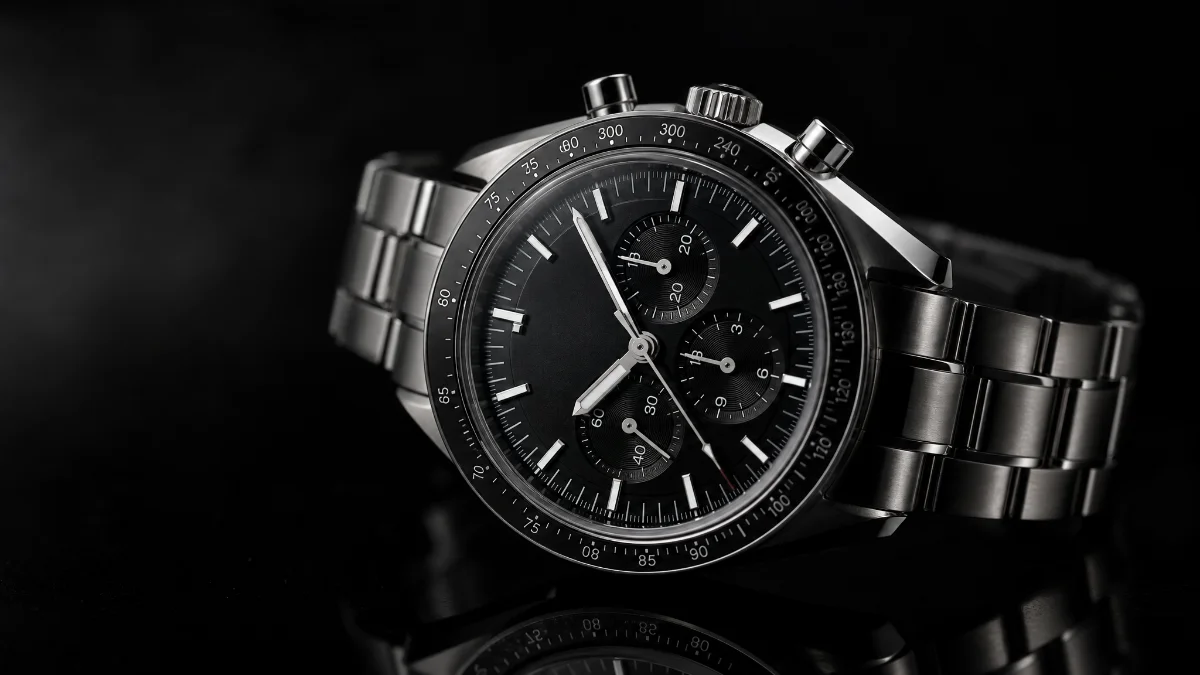
What’s easy to miss is that this isn’t a marketing story from decades ago — Omega has kept the modern Moonwatch Professional deliberately close to the 1969 design rather than modernising it away. The current model still uses a manually-wound chronograph movement, still comes with the option of the original acrylic (“Hesalite”) crystal, and still carries the same case proportions that flew to the Moon. That continuity is exactly what collectors are paying for.
What’s actually in the current line-up
The name “Speedmaster” now covers a genuinely wide range, but the Moonwatch Professional is the reference point for almost everyone buying into the collection, and it comes in two meaningfully different forms:
- Hesalite crystal, calibre 3861 — the historically faithful option, with a solid caseback and the same acrylic crystal used on the originals. Currently around £6,200–£6,600 new on a strap, depending on dial and bracelet configuration.
- Sapphire crystal, calibre 3861 — a scratch-resistant sapphire crystal front and a display caseback showing the movement, at a small premium over Hesalite, typically around £7,500 new.
Beyond the core Moonwatch, Omega also produces the Dark Side of the Moon (ceramic case, considerably higher price point), the Speedmaster ’57 (a different vintage-inspired case shape), and various anniversary and limited editions — the “Silver Snoopy” being one of the most sought-after and highest-premium examples on the pre-owned market. All current Moonwatch Professional models carry Master Chronometer certification, Omega’s own standard that goes beyond COSC to also test magnetic resistance and real-world performance across multiple positions and power states.
More than one Moon mission — why the story keeps going
The “flew to the Moon once” version of the Speedmaster story undersells it. Because NASA re-qualified the same reference for every subsequent crewed mission rather than approving a one-off exception, the Speedmaster has flown on every crewed NASA mission since Gemini, including every Apollo mission, Skylab, and the Space Shuttle programme. It’s also the watch that, according to the well-documented Apollo 13 account, was used by the crew to accurately time a critical 14-second engine burn that helped bring them home safely after the mission’s oxygen tank failure — arguably the moment the watch’s flight qualification actually mattered most, rather than the moonwalk itself.
That’s a genuinely different kind of heritage to most luxury sports watches, which trade on racing, diving or aviation associations that are more about brand image than a documented, repeated operational role. It’s worth knowing this history not because it should change what you pay, but because it explains why Omega has resisted modernising the core Moonwatch design anywhere near as much as most other manufacturers update their signature models.
Hesalite or sapphire — which should you buy?
This is the question we get asked most often, and there’s no wrong answer, only a different set of trade-offs:
- Hesalite scratches more easily day to day, but the scratches buff out at home with basic polishing compound — genuinely part of the ownership experience for purists, and historically accurate to the actual Apollo-era watches.
- Sapphire resists scratches far better and shows off the manually-wound movement through the caseback, but a chip or crack (rare, but possible) needs a full crystal replacement rather than a five-minute polish.
Neither is a compromise — it’s genuinely a matter of what you’d rather deal with. Collectors chasing the closest thing to the original Moon-landing watch tend to lean Hesalite; buyers who want to see the movement and don’t want to think about maintenance tend to lean sapphire.
Beyond the Moonwatch: the wider Speedmaster family
If you’re set on the Moon-landing connection specifically, the Moonwatch Professional is the only reference that matters. But it’s worth knowing what else carries the Speedmaster name, since pre-owned listings sometimes use the name loosely:
- Speedmaster ’57 — a different case shape inspired by the very first 1957 Speedmaster, generally slimmer and dressier, available with automatic movements rather than the Moonwatch’s manual wind.
- Dark Side of the Moon — a black ceramic case version of the Moonwatch silhouette, a significantly higher price point and a very different look, aimed at buyers who want the heritage without the traditional steel-and-white dial appearance.
- Speedmaster Racing — a more overtly motorsport-styled variant, distinct from the space-flight lineage, generally positioned as a more affordable entry into the collection.
None of these are “lesser” Speedmasters, but they’re genuinely different watches with different design goals, so it’s worth being clear on which one a listing is actually describing before you compare prices between two watches that only share a family name.
Servicing and running costs
A manually-wound chronograph movement like the calibre 3861 is mechanically more complex than a simple three-hand automatic, and that’s reflected in service costs. A full service through an authorised Omega service centre typically costs more than a standard time-only watch, and manual-wind chronographs generally benefit from slightly more frequent attention than automatics if worn hard. As with any pre-owned mechanical watch, ask for documented service history — it tells you far more about a watch’s true condition than the case finish does, and it’s a fair question to ask any dealer before you commit.
Speedmaster vs Rolex Daytona: the comparison worth understanding
The Speedmaster and the Rolex Daytona get compared constantly, and it’s a reasonable comparison to make since both are steel chronographs with serious motorsport and (in the Speedmaster’s case) space heritage. But the pre-owned dynamics are almost opposite. A steel Daytona is one of the hardest watches in the world to buy new at boutique price — years-long informal waiting lists push pre-owned prices well above retail. A Speedmaster Moonwatch Professional, by contrast, can generally be bought new, on the day, at an authorised dealer, which means pre-owned examples trade far closer to — and sometimes below — their original retail price.
The practical upshot: if the appeal is scarcity and long-term price appreciation, the Daytona currently has the edge, reflected in the premium pre-owned buyers pay for it. If the appeal is the watch itself — genuine spaceflight history, a manually-wound chronograph movement you can actually get hold of, and a lower entry price — the Speedmaster is very hard to beat, and arguably the more honest buy for someone who actually wants to wear rather than speculate on a watch. For more on how scarcity drives pricing on the Rolex side, see our guide on whether Rolex watches are a good investment.
What to check before buying a pre-owned Speedmaster
- Movement generation. The current calibre 3861 (Master Chronometer certified, introduced 2019 onward) replaced the older calibre 1861. Both are good, well-proven movements, but they’re not the same specification — know which one you’re being offered and that it’s reflected fairly in the price.
- Crystal type and condition. Confirm whether you’re looking at Hesalite or sapphire, and check a Hesalite crystal for deep scratches rather than assuming a quick polish will fix everything.
- Special editions need extra scrutiny. Anniversary pieces and limited runs (Snoopy, Silver Snoopy, various Moon-mission anniversary dials) carry a real premium and attract more counterfeiting attention than standard production references — independent authentication matters even more here.
- Box, papers and service history. As with any pre-owned watch at this price point, full documentation supports both authenticity and future resale value.
- Bracelet vs strap. Bracelet models command a premium over strap versions — worth checking which configuration a quoted price actually includes before comparing listings.
Buying from Motion Watches
Our current Speedmaster stock spans the range this history creates. A few examples from current stock at the time of writing:
- A Speedmaster Moonwatch Professional on Hesalite, the historically faithful entry point into the collection.
- A Speedmaster “Silver Snoopy” limited edition, one of the most sought-after collector references Omega has ever produced.
- A Speedmaster White, a recent colourway variant on the standard Moonwatch case.
- A Seamaster Bullhead Rio Olympics 2016 limited edition, for anyone interested in Omega’s wider chronograph output beyond the Speedmaster name itself.
That range is a fair reflection of the wider Speedmaster market — from an accessible, historically faithful entry point through to serious collector pieces. Stock moves quickly, so the best way to see exactly what’s currently available is to browse our current Omega stock directly. Every watch we sell is independently authenticated before it reaches you, and if you’re weighing up Hesalite against sapphire, or trying to work out whether a particular limited edition is fairly priced, we’re happy to talk it through before you commit. If a specific reference isn’t currently in stock, our watch sourcing service can look for it on your behalf.
Looking to sell a Speedmaster instead? We offer straightforward, no-obligation valuations based on current market conditions.
Why is the Omega Speedmaster called the Moonwatch?
NASA qualified the Speedmaster for spaceflight in 1965 after rigorous testing, and Buzz Aldrin wore his on the lunar surface during the Apollo 11 moonwalk in July 1969 — the origin of the “Moonwatch” name.
Is the Speedmaster Moonwatch hand-wound or automatic?
The standard Moonwatch Professional is manually wound, using the calibre 3861 movement — a deliberate link to the historically accurate, manually-wound movements used in the original Apollo-era watches.
Is a Speedmaster a good investment?
Standard production Moonwatch Professional models hold value reasonably well but aren’t known for the scarcity-driven appreciation seen with some Rolex sports models. Limited editions and vintage references are a different story and can command significant premiums.
What’s the difference between Hesalite and sapphire crystal Speedmasters?
Hesalite is the original acrylic crystal material, historically accurate and repairable with basic polishing if scratched. Sapphire is more scratch-resistant and comes with a display caseback showing the movement, at a price premium.
Does Motion Watches buy Speedmasters too?
Yes. We buy and value Speedmasters and other Omega models directly, with a straightforward, no-obligation valuation process.