IWC Schaffhausen doesn’t get talked about in the same breath as Rolex or Patek Philippe nearly as often as it should. That’s partly the brand’s own doing – IWC has always been happier letting the engineering do the talking than chasing hype – but it leaves a gap for buyers who want serious Swiss watchmaking without queuing for an allocation or paying a premium over retail. If you’re looking at a pre-owned IWC for the first time, here’s what the brand is actually about, what to check before you buy, and what we currently have in stock.
A Brief History of IWC Schaffhausen
IWC was founded in 1868 by Florentine Ariosto Jones, an American engineer who travelled to Switzerland to combine Swiss watchmaking skill with the kind of industrial manufacturing methods that were still rare in the trade at the time. He set up in Schaffhausen, in the German-speaking north of the country, rather than the traditional watchmaking valleys further south – which is why the brand still carries the city’s name rather than a canton most people associate with Swiss watches.
That engineering-first identity has stuck. IWC’s reputation was built on tough, legible, purpose-built watches rather than dress pieces, and nowhere is that clearer than in its aviation watches, which are the collection most buyers come to the brand for.
The Pilot’s Watch: Where It Started
The Pilot’s Watch line traces back to the late 1930s, when IWC built the B-Uhr (Beobachtungsuhr, or “observation watch”) for Luftwaffe navigators. It needed an oversized case, a crown big enough to operate with gloves on, and a dial that could be read at a glance in a moving cockpit. Those three requirements – size, a glove-friendly crown, high-contrast legibility – still define the collection nearly ninety years later.
The next landmark came with the Mark 11, developed for the Royal Air Force in the late 1940s. Later Mark references, right up to today’s Mark XX, are modelled on it. If you want one watch that sums up what IWC is for, it’s the Mark line.
The Current Pilot’s Watch Lineup
IWC’s modern Pilot’s Watch collection splits into several distinct families, and knowing the difference matters when you’re comparing pre-owned examples:
- Mark XX – the current entry point and the most direct descendant of the wartime original. 40mm in steel, with short lug-to-lug dimensions that wear smaller than the dial size suggests. It runs IWC’s in-house calibre 32110.
- Big Pilot – 43mm and up, built around the distinctive oversized onion crown. Movements range from simple three-hand automatics to perpetual calendars and tourbillons, so pricing spans from the mid-range right up to six figures in precious metal with complications.
- Spitfire – a WWII-themed sub-line in bronze and steel, with chronograph references built on IWC’s column-wheel calibre 69380.
- Top Gun – developed with the US Navy’s elite fighter training programme, built from ceramic, titanium-ceramic or Ceratanium rather than steel. This is where IWC’s material science is most on display, and it’s the line we currently have in stock – more on that below.
There’s also a Le Petit Prince line (2026 marks its 20th anniversary) with deep blue dials across several of the families above, but it’s a dial treatment rather than a separate case architecture.
On price, as a rough guide: a steel Mark XX is the most accessible entry point into current production, Spitfire chronographs sit a tier above that, and Big Pilot pricing spans the widest range of any IWC family, from a simple steel three-hander up to precious-metal references with a perpetual calendar or tourbillon. Top Gun pricing depends heavily on case material and complication – an automatic three-hander in ceramic costs meaningfully less than a chronograph in the same material, which in turn costs less than anything with Ceratanium or a more complex movement. Treat any figure you see quoted online as a starting point rather than gospel; always check current pricing with a dealer before you commit to a specific reference.
Inside the Watch: IWC’s In-House Movements
One of the genuine reasons to take IWC seriously is that it builds its own movements rather than relying on third-party suppliers, and has done so increasingly since phasing out ETA and Valjoux-based calibres.
The calibre 32110, found in the Mark XX, is built around IWC’s own Pellaton automatic winding system – a bidirectional pawl-winding mechanism IWC has used and refined since the 1950s – and delivers around 120 hours of power reserve, roughly three times what you’d get from a standard Swiss automatic. For the chronograph models (Spitfire and Top Gun chronographs), IWC uses the in-house calibre 69380, a column-wheel chronograph movement with around 46 hours of power reserve, 33 jewels and a 28,800vph beat rate, introduced specifically to move the brand away from outsourced Valjoux 7750-based chronographs.
The practical upshot for a buyer: a Mark XX or Top Gun automatic will comfortably run over a long weekend without being worn, which matters more than it sounds once you own more than one watch.
Top Gun: Ceramic, Colour and a Genuine Military Link
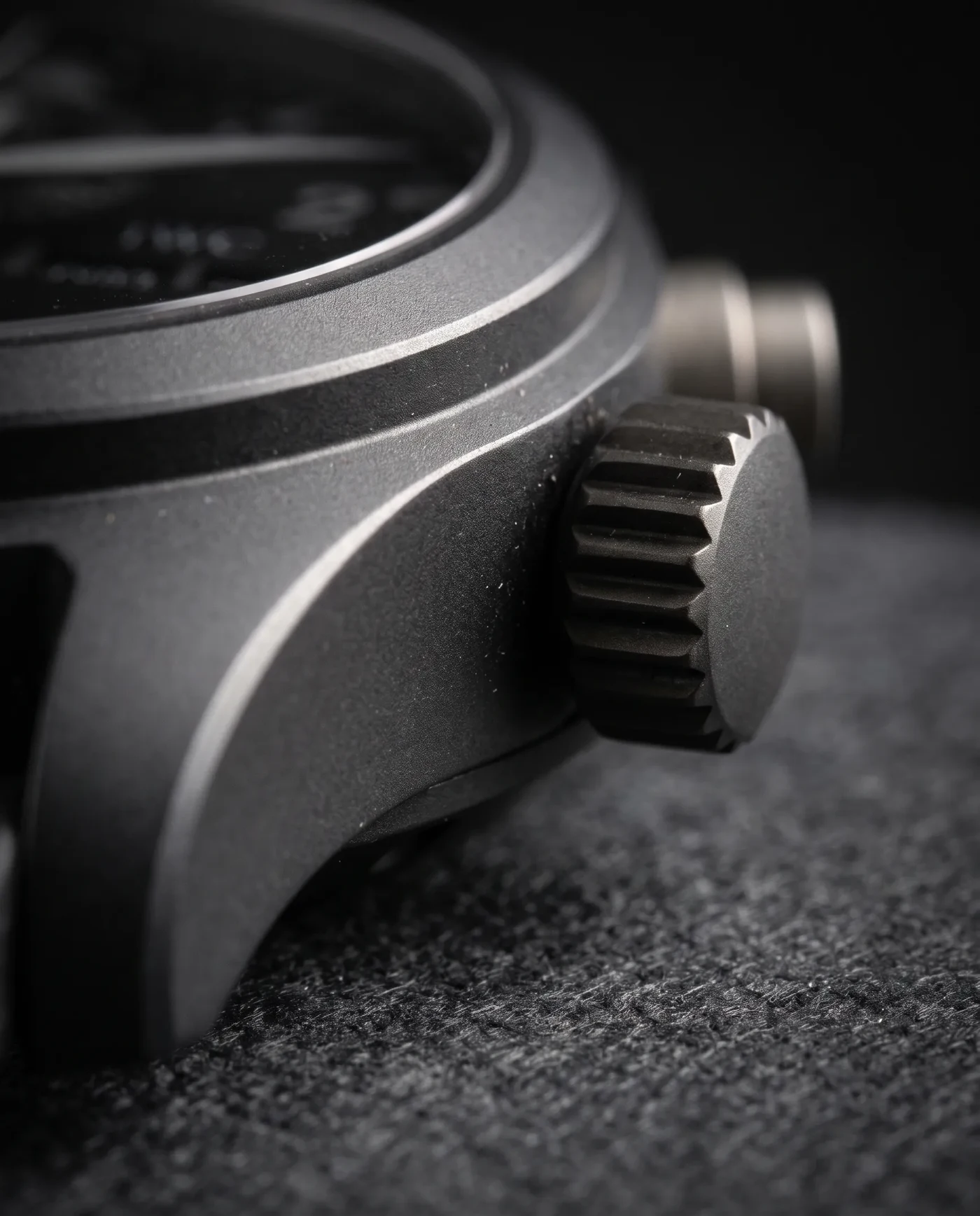
The Top Gun name isn’t marketing spin. IWC has built watches for the US Navy’s Strike Fighter Tactics Instructor programme (the real “Top Gun” school) since 2007, when the first Top Gun chronograph arrived in a black zirconium oxide ceramic case. Ceramic was chosen because it’s scratch-resistant, lightweight and doesn’t corrode – genuinely useful properties in a cockpit, not just a selling point on a spec sheet.
More recently, IWC has worked with Pantone to specify a range of ceramic colourways inspired by naval aviation colour codes and the landscapes pilots train over – sand tones for desert training grounds, deep greens for woodland exercises, and so on. The two watches we currently have in stock are good examples of this: a woodland green chronograph and a sand-toned “Mojave Desert” automatic, both covered in detail below.
How IWC Sits Against Rolex, Omega and Tudor
If you’re used to shopping Rolex or Omega, IWC’s positioning is worth understanding before you buy. New Top Gun pieces retail at a meaningful premium to steel Rolex sports models of a similar size, reflecting the ceramic case construction and in-house movement, but IWC doesn’t carry anything like the same waiting-list culture or secondary-market premium over retail that Rolex does. That cuts both ways: you’re far less likely to pay over the odds for a Top Gun than for a steel-bracelet Submariner, but you also shouldn’t expect the same resale strength if the watch isn’t something you intend to keep. We’d rather tell you that plainly than let you assume IWC behaves like Rolex just because the price tags are in a similar range – the two brands reward different buying motivations, and IWC’s is “that’s a genuinely well-made watch I want to wear” rather than “that’s an appreciating asset.”
Running Costs Worth Knowing About Before You Buy
None of this is specific to IWC, but it’s worth saying plainly rather than leaving you to find out later. A service at an authorised IWC centre, when one is eventually needed, typically runs into several hundred pounds depending on the complication and whether parts need replacing – budget for it rather than treat it as a surprise. Ceramic and titanium-ceramic cases don’t need the same polishing that steel does, which is one of the quieter advantages of the Top Gun line, but a cracked ceramic section can’t be polished out the way a steel scuff can, so insurance is worth considering for anything you’re not planning to keep in a drawer. None of this makes an IWC expensive to live with – it’s simply the same ownership discipline that applies to any serious mechanical watch.
Buying Pre-Owned: What to Check Before You Commit
A pre-owned IWC is a sound purchase if you do the same checks you’d do for any serious watch:
- Box and papers. A full set (warranty card, outer box, booklets) supports both authenticity and future resale, and should be asked about directly rather than assumed.
- Service history. Ask when the movement was last serviced. IWC’s own recommended interval is roughly every five to seven years; a watch with no service history isn’t a dealbreaker, but it should be reflected in the price or factored into your first-year running costs.
- Ceramic and case condition. Ceramic resists scratches well but can chip on a hard knock, and a chip doesn’t polish out the way a scuff on steel does. Inspect the case edges and lugs closely, ideally under a loupe or strong light.
- Strap and bracelet wear. Rubber and textile-inlay straps age differently to leather or steel – check for cracking, discolouration or a loose pin buckle.
- Movement accuracy. A quick timing check against a reference clock over 24 hours will tell you if the movement is running within a reasonable tolerance, though this is something a dealer or independent watchmaker can check properly for you.
How to Avoid a Fake IWC
IWC isn’t counterfeited anywhere near as heavily as Rolex or Patek Philippe, but it isn’t immune either, and the same discipline applies. A serial number on its own proves nothing – IWC has kept sequential production records since 1868, which is useful for dating a genuine watch, but counterfeiters have been known to copy real serial numbers onto fake cases. What actually tells you something is whether the serial on the case back matches the one on the warranty card, and whether that serial’s known production range is consistent with the watch’s reference and year.
Beyond the serial, look at dial printing quality (crisp and evenly spaced text, properly aligned sub-dials), the sharpness of case-back engraving, and whether the sapphire crystal has the anti-reflective coating you’d expect – excessive glare is a common tell on poor-quality fakes. If you’re ever in doubt on a watch you’re not buying from an established dealer, an independent authentication or a formal certificate from IWC itself is worth the time and the fee. We’ve written a longer general guide to spotting a fake luxury watch covering the same principles in more depth, and every watch we sell is backed by Motion Watches’ own 100% Authenticity Guarantee regardless of brand.
What’s In Stock at Motion Watches Right Now
We’ll be straightforward here rather than imply a bigger range than we have: IWC is a newer addition to our stocked brands, and at the time of writing we hold two Pilot’s Watch Top Gun pieces, both genuine full sets:
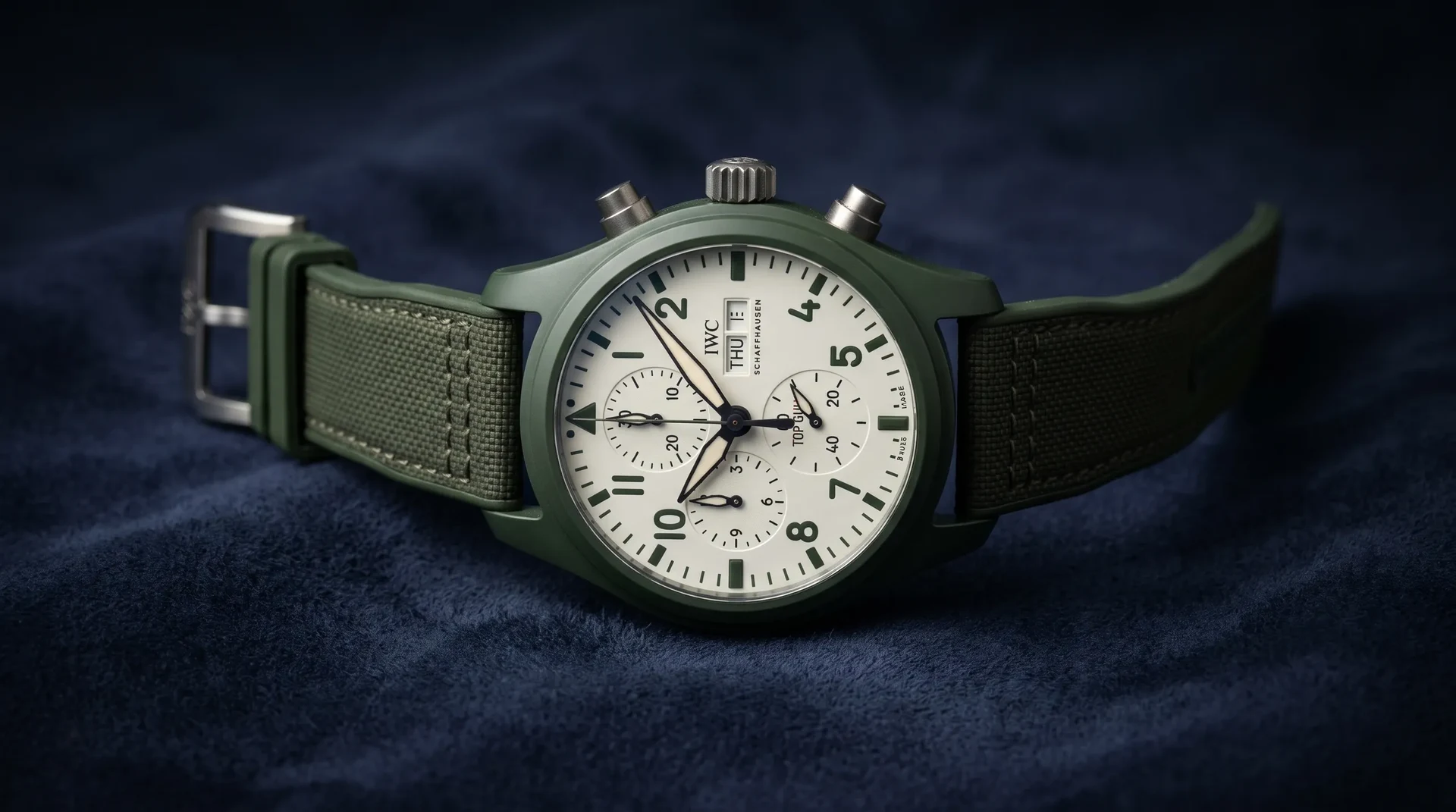
- IWC Pilot’s Chronograph Top Gun 44 “Woodland” Green (IW389106, 2025) – a 44mm ceramic-cased chronograph with a green dial, white Arabic numerals and the in-house calibre 69380 column-wheel movement. Supplied on its original green rubber/canvas strap, with box and papers, in excellent condition with minimal signs of wear. £6,495.
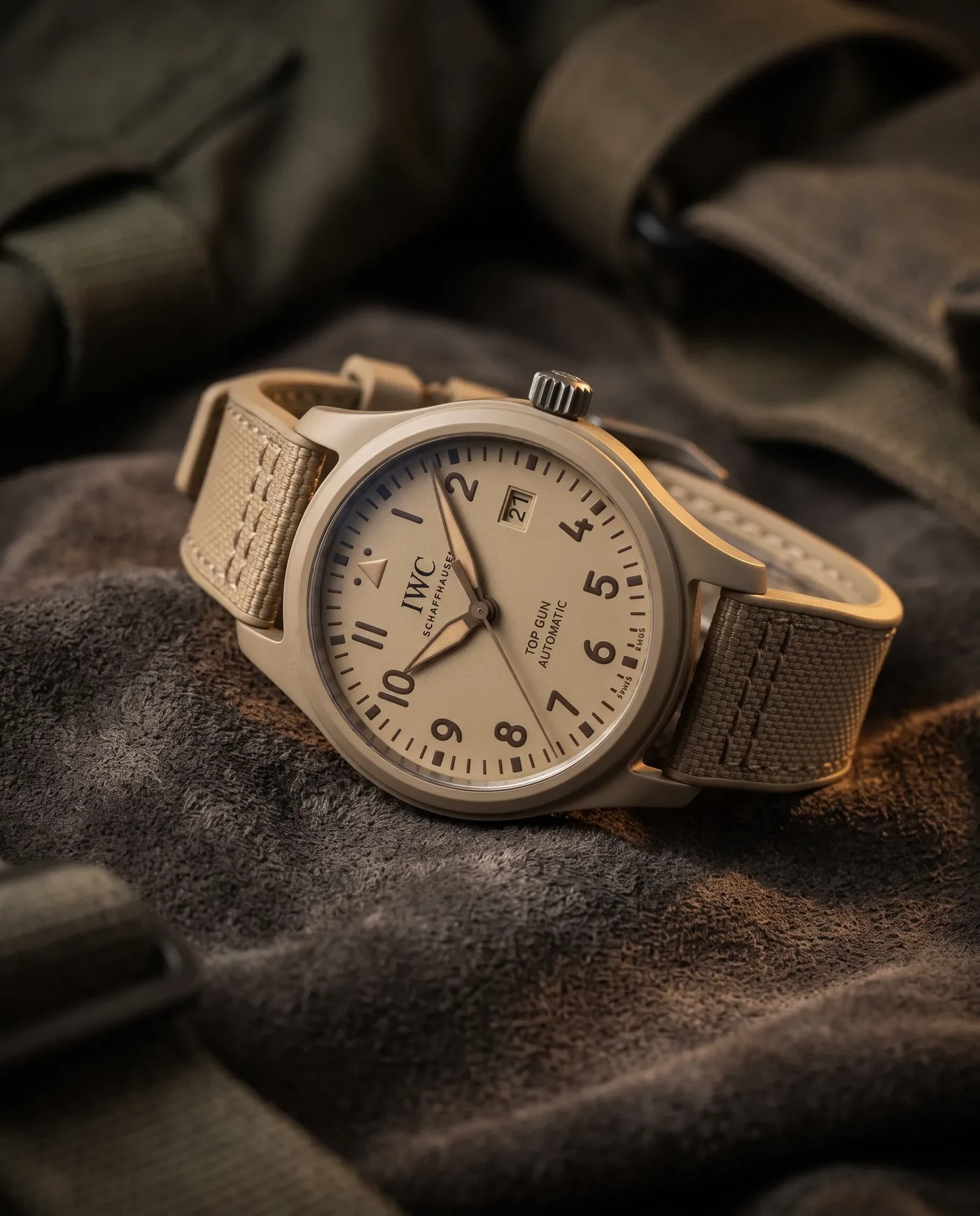
- IWC Pilot’s Watch Automatic 41 Top Gun “Mojave Desert” (IW328106/W389402, 2023) – a 41mm sand-toned ceramic case with a desert-themed dial and roughly 120 hours of power reserve from the Pellaton-wound automatic calibre. Sold in mint condition as a full set with warranty card, travel case, outer box and booklets. £6,550.
If you’re after a different reference – a Mark XX, a Big Pilot, a Spitfire or a Portugieser, say – that’s exactly what our watch sourcing service is for. Rather than waiting for the right piece to turn up by chance, we use our dealer and collector network to find a specific model and condition on your behalf, with no obligation until you’ve seen and approved the watch.
Buying, Selling or Sourcing an IWC
Whichever direction you’re coming from, the process with us is the same: no pressure, no part-exchange gimmicks we can’t actually offer, and no guesswork on authenticity. If you’ve found the Top Gun you want above, or want us to source something specific, get in touch and we’ll talk you through it – finance is also available on qualifying purchases if that’s useful. And if you’re the one holding an IWC (or any luxury watch) you’re thinking of selling, our valuation page explains how we assess condition, box and papers, and current market demand to give you an honest, no-obligation figure, in person at our Ipswich showroom or by appointment further afield.
IWC rewards buyers who care more about engineering and build quality than brand status alone. If that’s you, a Top Gun or a sourced Mark XX is a genuinely satisfying watch to own – just go in with realistic expectations on resale, and do the same checks you’d do on any serious purchase.