Why “How Much Is My Watch Worth?” Doesn’t Have a One-Line Answer
If you’ve typed “how much is my watch worth” into Google, you’ve probably found the same thing most sellers do: a handful of online calculators that ask for a reference number and spit out a price range, and not much else. The honest answer is that a luxury watch’s value depends on far more than its model number. Two examples of the same reference, in the same metal, can be worth noticeably different amounts once you factor in condition, papers, service history and what the market is doing for that specific piece right now.
This guide walks through what actually moves a luxury watch’s value, why an automated estimate and a proper in-person valuation can land in very different places, and what to have ready before you get yours valued.
What Actually Determines a Luxury Watch’s Value
A valuation isn’t just “what did this reference sell for last month.” A specialist is weighing up several things at once:
- Brand and model. Some brands and references hold their value far better than others because demand consistently outstrips supply — certain Rolex sports models and Patek Philippe references are the best-known examples. Others track closer to typical retail depreciation.
- Condition. Case and bracelet wear, dial condition, and whether the movement has been serviced on schedule all affect price. A watch that’s been well looked after will outvalue an identical reference that’s been knocked about, even if neither has anything seriously wrong with it.
- Box, papers and accessories. A full set (original box, warranty card or extract, purchase receipt, and any extra links or straps) adds genuine value and makes a watch easier to sell on. A watch with no papers isn’t worthless, but expect the offer to reflect that.
- Service history. Evidence of regular servicing from an authorised source or a reputable independent watchmaker reassures a buyer the movement has been looked after, which supports the price.
- Current market demand. Secondary-market watch prices move. A reference that was commanding a premium over retail a couple of years ago may have settled back since, and vice versa. Any valuation is a snapshot of the market on the day, not a fixed number.
- Age and rarity. Discontinued references, unusual dial variants, and special editions can carry a premium with the right buyer, particularly if they’re well documented.
None of this is exact science, which is exactly why two different valuations of the same watch can land in different places. It’s also why we’d always be cautious of anyone offering a confident number without actually looking at the piece.
Retail Value, Insurance Value and Resale Value Are Three Different Things
One of the most common points of confusion we see is sellers assuming their watch is worth whatever a jeweller would charge to sell it new, or whatever figure their insurance policy lists it at. In reality, there are several distinct figures that all apply to the same watch:
- Retail price is what you’d pay a boutique or authorised dealer for a brand-new example today, assuming you could get hold of one.
- Insurance replacement value is usually set at or slightly above retail price, since it needs to cover the cost of replacing the watch new if it’s lost, stolen or damaged beyond repair.
- Secondary-market (resale) value is what a private buyer or dealer will actually pay for your specific watch, in its specific condition, today. For certain in-demand references this can sit close to or even above retail. For most watches, it sits below retail, in the same way a car loses value the moment it’s driven away from the forecourt.
When you’re selling, it’s the secondary-market value that matters; an insurance certificate or a retail price list is not a selling price. Being upfront about that distinction from the start avoids any disappointment further down the line, and it’s something a specialist valuation will always walk you through.
How Brand and Model Affect What You’re Likely to Be Offered
Value dynamics differ quite a bit from brand to brand, and it’s worth understanding the general picture before you go in, even though every valuation still comes down to the individual watch:
- Rolex sports models (Submariner, Daytona, GMT-Master II and similar) have built a long track record of holding value well, largely because retail demand for new pieces still outstrips supply at authorised dealers. That doesn’t mean every Rolex sells at a premium; dress watches and older references behave more like the wider market.
- Patek Philippe, particularly steel sports references such as the Nautilus, sees some of the strongest demand in the entire secondary market, often with long waiting lists for new pieces pushing buyers toward pre-owned. More classical Patek references, such as Calatrava models, tend to track closer to standard depreciation.
- Audemars Piguet Royal Oak models have followed a similar pattern to Patek’s sports watches, with strong demand for in-demand references, though the market corrected from its 2021–2022 peak and has settled since.
- Omega, Tudor and Cartier generally see steadier, less speculative demand. They’re not typically bought as an investment vehicle, which in some ways makes their resale values more predictable and less prone to sudden swings.
- Richard Mille commands very high prices new and on the secondary market, but because pieces are produced in limited numbers and sold largely through the brand’s boutique network, valuations here benefit especially from an expert who understands the specific reference and its production numbers.
Whatever you own, treat any of the above as general context rather than a promise of what your watch will fetch. The only way to get a figure you can actually rely on is to have the specific watch looked at.
Is There a Best Time to Sell?
Secondary-market watch prices move with broader demand, so in theory timing can make a difference, particularly for the small number of references that see real speculative interest. In practice, trying to time the market precisely is difficult even for people who follow it closely, and for the vast majority of watches the difference between selling this month or next is marginal compared with the difference condition, papers and service history make. If you’re selling because you want the money or you’re not wearing the watch any more, waiting for a theoretically perfect moment usually isn’t worth the uncertainty. If you’re genuinely undecided, a no-obligation valuation at least tells you where things stand today without committing you to anything.
Why an Online Calculator Isn’t the Same as an Expert Valuation
Automated “get an instant quote” tools have their place for a rough first impression, but they work from averages: they typically take a reference number and a condition tick-box and return a generic range based on recent sales of that reference. What they can’t do is physically assess your watch, which means they can’t account for:
- The actual condition of the case, dial, bracelet and movement, rather than a self-reported estimate
- Whether a watch has been polished, has replacement parts, or has had any after-market modifications
- Genuine rarity within a reference, such as an unusual dial colour or a discontinued configuration
- Whether the papers and box genuinely match the watch
- What’s actually happening in the market for that specific piece this month, rather than an average over the last several months
That’s why, at Motion Watches, every valuation is carried out in person by an expert rather than through an automated pricing tool. It takes a bit longer than typing a reference number into a website, but it means the figure you’re given actually reflects the watch in front of us, not a generic average.
What to Have Ready Before a Valuation
You don’t need everything on this list to get a valuation, but the more you can bring, the more accurate and often the higher the offer is likely to be:
- The watch itself, obviously, along with any spare links or straps
- Original box and papers (warranty card, extract from the archives, or purchase receipt), if you still have them
- Any service records or receipts, even informal ones, showing when the watch was last looked at
- Details of how and when you acquired the watch, if you’re able to share them
- Any independent authentication documents, if the watch has previously been authenticated
If you’ve lost the box and papers over the years, that’s genuinely common and not a dealbreaker; it simply means the valuation will be based on the watch alone rather than a complete set.
How a Valuation With Motion Watches Works
We deliberately don’t do automated quotes or ask you to post a watch off to an unknown address. The process is straightforward and stays in your control at every stage:
- Tell us about your watch. Complete our watch valuation enquiry form with the brand, model, year and condition, and one of our team will get back to you to arrange a private consultation.
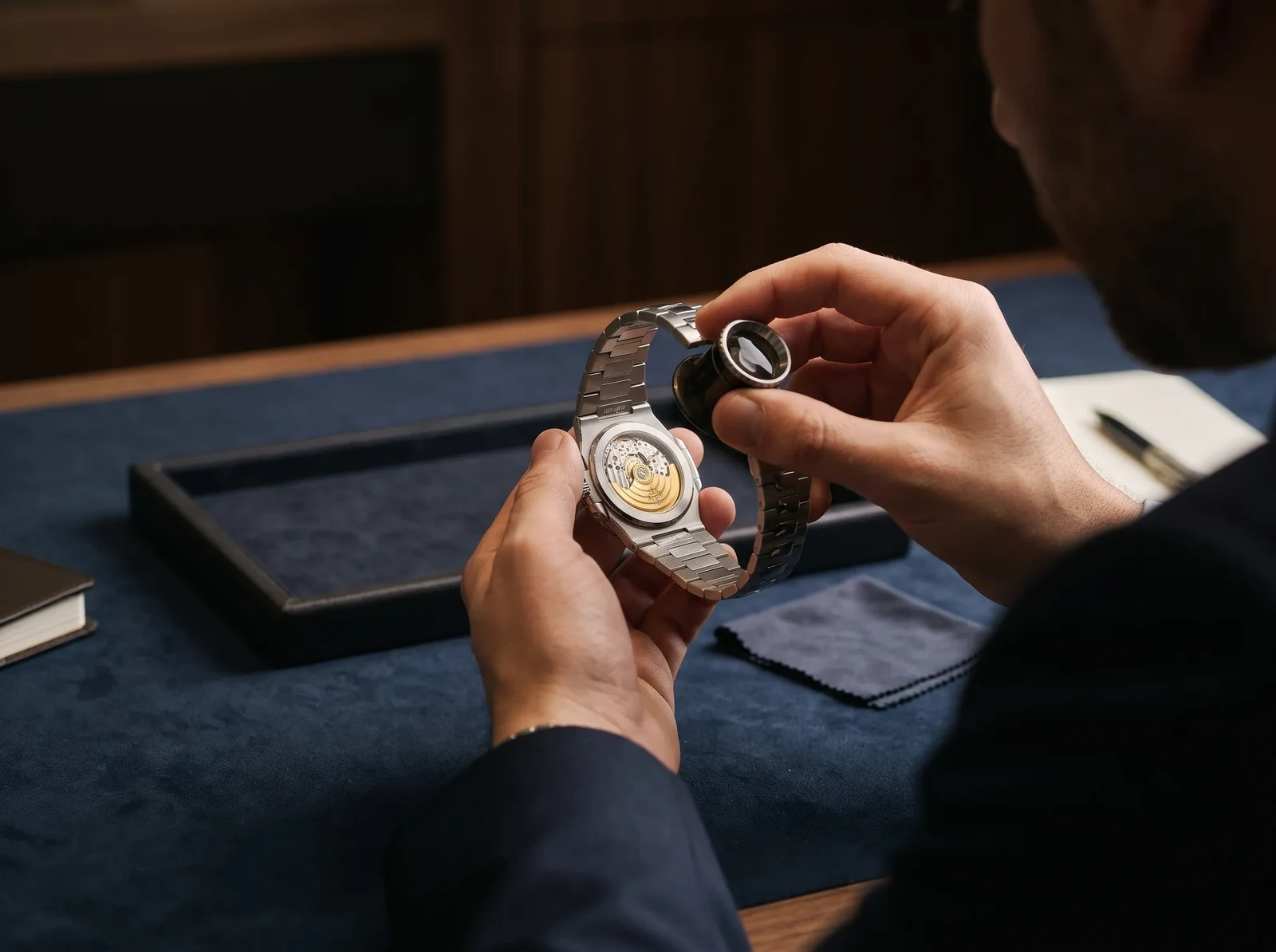
- In-person inspection. We’re based at our showroom in Ipswich, and we also meet clients by appointment across the wider East Anglia region and in London. At your appointment, we examine the watch in person, confirm its condition, and talk you through how we’ve arrived at the figure.
- A fair, no-obligation offer. You’ll get a clear figure with no hidden deductions, and no pressure to accept it on the spot. If you want to think it over, that’s entirely fine.
- Prompt payment if you go ahead. If you decide to sell, we handle the handover and payment promptly, face to face.
There’s no part-exchange scheme at Motion Watches, so if you’re looking to trade one watch directly against another, a valuation followed by a straightforward sale (and a separate purchase, if you want one) is how that works here.
Common Questions We’re Asked About Valuations
Does a watch need to be working to be valued?
No. We can still give you a valuation on a watch that isn’t currently running, though the expected cost of any servicing it needs will usually be reflected in the figure.
Is a valuation the same as an offer to buy?
Not necessarily, though in most cases we’re able to combine the two: a valuation tells you what your watch is realistically worth on today’s market, and where we’re able to buy it ourselves, we’ll turn that into a firm, no-obligation offer during the same appointment.
How long does a valuation take?
A straightforward valuation can usually be done within your appointment. More unusual or complicated pieces, such as vintage watches needing further research, may take a little longer.
Will you buy my watch even if it’s not one of the brands you usually stock?
Get in touch and ask. We focus on a specific range of luxury brands, but we’re happy to discuss watches outside that list on a case-by-case basis.
Should I get more than one valuation?
There’s nothing wrong with doing so, and it’s a reasonable way to sanity-check a figure, particularly for a higher-value piece. What matters more than the number of valuations is the quality of each one: an in-person assessment from someone who deals in that brand day to day will tell you more than several automated online quotes put together.
What should make me cautious when selling elsewhere?
Be wary of any buyer offering a firm price before they’ve seen the watch, anyone asking you to post a valuable watch to an address you can’t verify, and offers that seem unusually high with pressure to accept quickly. A legitimate valuation should involve someone actually examining the watch and should never require you to commit on the spot.
Getting Your Watch Valued
If you’re weighing up whether to sell, the simplest next step is a proper valuation rather than guessing from an online average. It costs you nothing to find out, there’s no obligation to sell once you know the figure, and you’ll be speaking to someone who has actually looked at your watch rather than a generic reference-number lookup. You can start by completing our watch valuation form, or get in touch with our team directly if you’d rather talk it through first.