Bell & Ross doesn’t get talked about as often as Rolex or Patek Philippe, but it occupies a genuinely different space in the pre-owned market: instrument-inspired watches built around a single idea, with a square case that nothing else in luxury watchmaking quite matches. If you’re considering a Bell & Ross for the first time, here’s what you actually need to know before you buy one, pre-owned or otherwise.
Who Makes Bell & Ross? A Brief History
Bell & Ross was founded in the early 1990s by Bruno Belamich (the designer, “Bell”) and Carlos A. Rosillo (the businessman, “Ross”), who met at business school and built the company around a simple brief: watches made for people who actually need them to work under pressure – pilots, divers, bomb disposal technicians, astronauts. The brand is based in Paris, with manufacturing handled in La Chaux-de-Fonds, Switzerland, inside a facility part-funded by Chanel, which has held a minority stake in Bell & Ross since the late 1990s.
Early Bell & Ross watches were produced in partnership with the German tool-watch specialist Sinn, and the brand’s first notable hit – the Space 1 chronograph – was closely related to a Sinn design. That partnership ended in the early 2000s as Bell & Ross moved its own production to Switzerland and began developing the design language it’s known for today. The breakthrough came in 2005 with the BR 01: a genuinely square-cased wristwatch modelled directly on an aircraft cockpit instrument, right down to the four corner screws holding the bezel in place. It was unlike anything else on the market, and it’s still the clearest expression of what the brand is trying to do three decades on.
The Design Philosophy: Function Dictates Form
Most luxury watch brands start with a case shape and then decide what to put inside it. Bell & Ross works the other way round. The founding idea behind the BR 01 and its smaller sibling the BR 03 was to take the most legible instrument in the world – a cockpit clock – and put it directly on the wrist, square bezel, oversized numerals and all. The result is a watch that reads cleanly at a glance, which is exactly the point: instrument design has no room for decoration that doesn’t earn its place.
That philosophy runs through the brand’s three main families. Aviation watches (the BR 01 and BR 03 ranges) take their language from cockpit dashboards. Marine watches lean into diving-instrument functionality. Vintage pieces, including recent reissues like the WW1 and the BR V line, look back to earlier 20th-century military watches with softer, more rounded cases. It’s a narrower, more consistent design identity than most brands manage, which is part of why Bell & Ross has built such a recognisable following despite being a smaller name than the likes of Rolex or Omega.
The BR-X5: Bell & Ross’s Sports Watch With an Integrated Bracelet
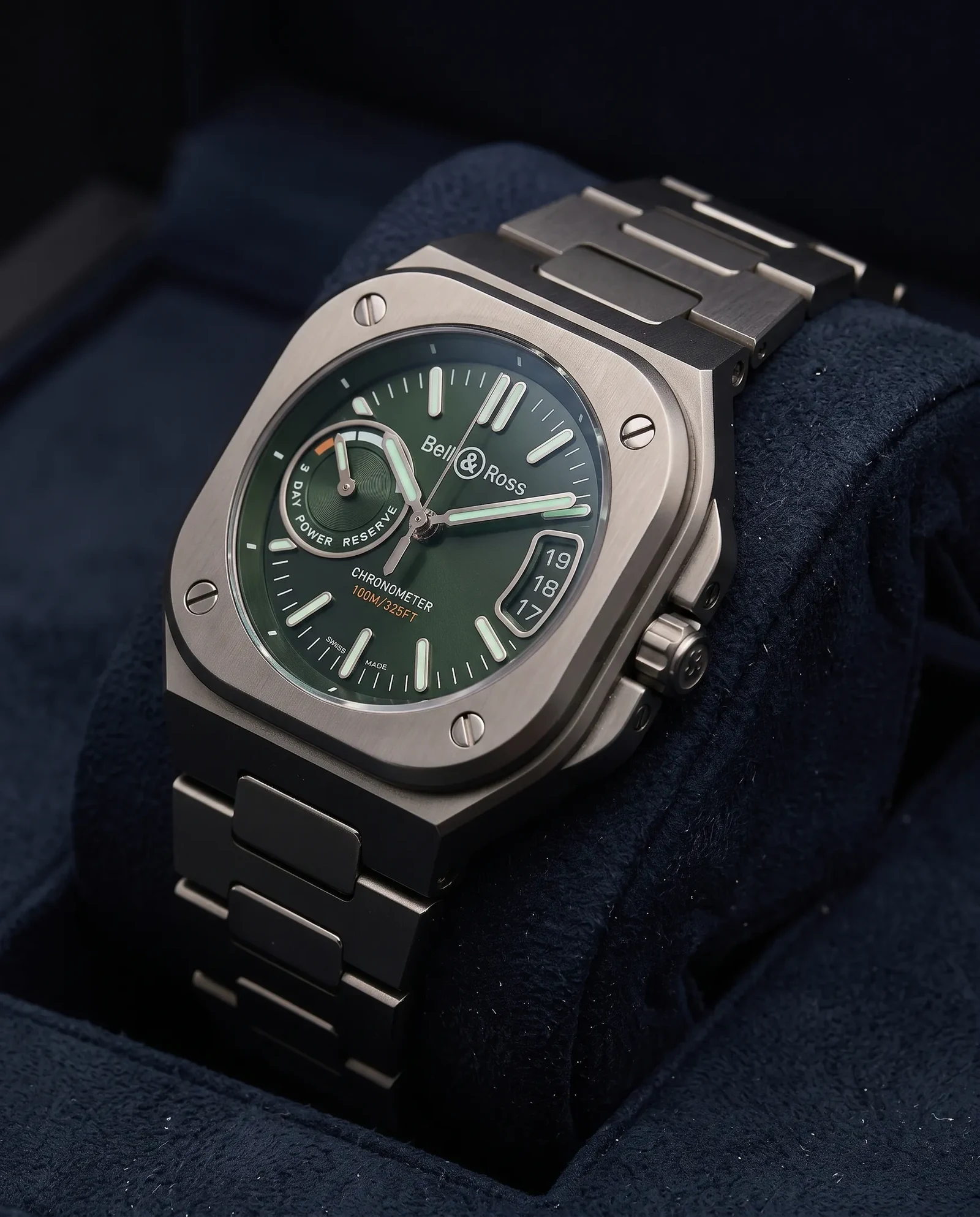
The BR-X5, launched in October 2022, is Bell & Ross’s answer to the integrated-bracelet sports watch category that Royal Oak and Nautilus made famous – built on the square case the brand already owns, rather than copying anyone else’s round one. It uses a steel case construction with a separate bezel and caseback, available on a steel bracelet or rubber strap, and in a titanium-and-carbon-composite “Carbon” edition for the higher end of the range.
The significant change with the BR-X5 is the movement: the in-house BR-CAL.323, manufactured for Bell & Ross by Kenissi – the movement maker majority-owned by Tudor and part-owned by Chanel – and closely related to the calibre used in Tudor’s own Black Bay Pro and GMT models. It’s COSC-certified as a chronometer, runs at 28,800 vibrations per hour with a free-sprung balance, and carries a genuinely useful 72-hour power reserve, along with a power-reserve indicator on the dial. At launch, BR-X5 models were priced from roughly $6,900 to $11,800 depending on the finish and strap, which puts the range in direct competition with Tudor’s own Black Bay Pro and the entry-level Royal Oak market – worth bearing in mind if you’re cross-shopping. We’d suggest treating that as a rough guide to how the range sits rather than a current UK retail figure, since official pricing moves and varies by edition.
Motion Watches currently has a BR-X5 Green Lum Limited Edition in stock (reference BRX5R‑LUM‑TC/SRB) – a case finished in DLC-coated titanium with a green lume-effect dial, part of a run built around high-visibility, sandwich-style luminous markers rather than a standard lacquered finish. If you’re after the BR-X5 specifically, it’s worth asking us for the exact spec, since limited editions like this one don’t come back into stock once they’re gone.
The BR 03-94: A Military Chronograph, Reissued Honestly
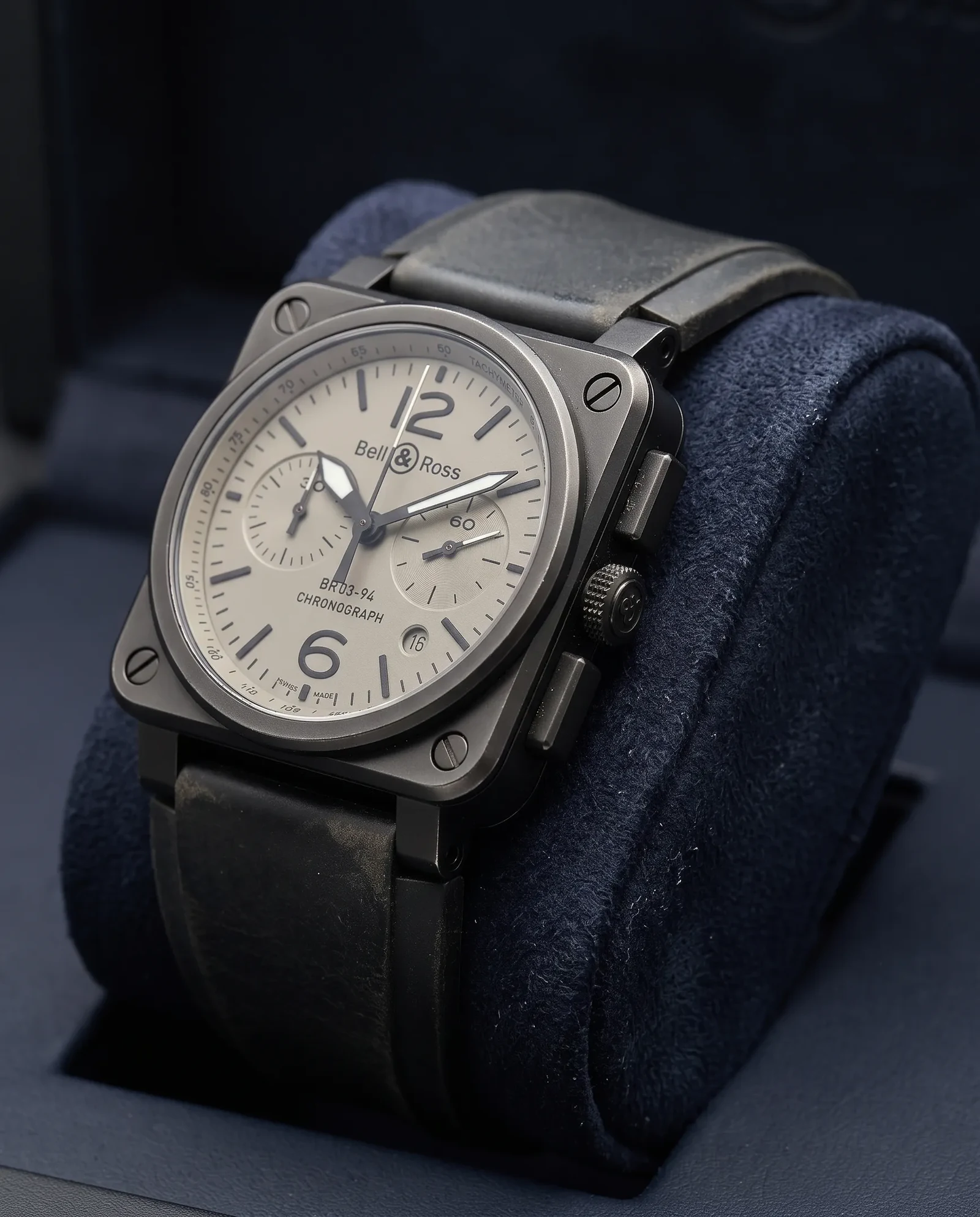
Where the BR-X5 is Bell & Ross looking forward, the BR 03-94 range looks back. The 94 is the brand’s chronograph platform within the BR 03 family – a 42mm square case, smaller and more wearable than the original 46mm BR 01, with the same four-corner-screw bezel and cockpit-instrument dial layout, built around the in-house BR-CAL.301 chronograph movement.
The variant Motion Watches currently stocks is the BR 03-94 Commando: a steel case with a dark coating, matte military-style dial, and a webbing or rubber strap that nods directly to the tool-watch heritage the Commando name references – the kind of watch issued to, or inspired by, military units rather than designed for a showroom window. It’s a smaller financial step into Bell & Ross than the BR-X5, and arguably the more honest expression of what the brand was originally built to do.
Military and Government Heritage
Bell & Ross has built a genuine (not marketing-invented) track record of supplying watches to specific military and government units, which is worth knowing because it explains a lot of the brand’s design choices. The French Air Force’s Escadron de Chasse 2/4 “La Fayette” fighter squadron selected the BR 03 Aviation as its official watch after a competitive process against other brands. The Groupe d’Intervention de la Gendarmerie Nationale – France’s elite police tactical unit, broadly comparable to a SWAT team – uses Bell & Ross watches as standard-issue equipment. The brand also makes dedicated pieces for French civilian bomb disposal (EOD) units, including a Type Démineur model built with a soft-iron inner case to shield the movement from magnetic fields, a genuinely functional feature rather than a styling cue. Bell & Ross has also been the official watch supplier to the French space programme.
None of this means every Bell & Ross you can buy is the exact watch a French fighter pilot or EOD technician wears on duty – most of the current catalogue, including the BR-X5 and the Commando, is a civilian product inspired by that heritage rather than a literal reissue of military-issue hardware. But the relationships are real and well documented, and they’re a big part of why the brand’s design language reads as authentic rather than borrowed.
Movements: What’s Inside a Bell & Ross, and Why It Matters
Bell & Ross’s movement strategy has shifted over the brand’s history. Earlier and entry-level models relied on outsourced ETA or Sellita movements – perfectly reliable, widely serviced, but not something the brand could claim credit for engineering. The more recent, higher-end pieces have moved towards in-house or part-owned calibres: the BR-CAL.301 chronograph movement in the BR 03-94 range, and the Kenissi-built BR-CAL.323 in the BR-X5, which is COSC-chronometer certified and shares its architecture with Tudor’s own manufacture movements.
For a buyer, this matters for two practical reasons. First, servicing: a Kenissi-based or Bell & Ross in-house calibre is a different proposition for parts and servicing than an older ETA-based model, so it’s worth knowing which movement a specific piece carries before you commit, especially on an older pre-owned example. Second, it affects how the watch should be valued and compared – a BR-X5 on an in-house chronometer movement sits in a genuinely different conversation to an entry-level quartz or ETA-based Bell & Ross from a decade ago, even though both carry the same badge on the dial.
How to Check a Bell & Ross Is Genuine
Bell & Ross isn’t counterfeited at anything like the scale of Rolex or Patek Philippe, but it isn’t immune either, and the brand’s distinctive square case has started to attract more fakes as its profile has grown. The checks that matter are the same ones that matter for any pre-owned luxury purchase, and they’re worth taking seriously rather than treating as a formality:
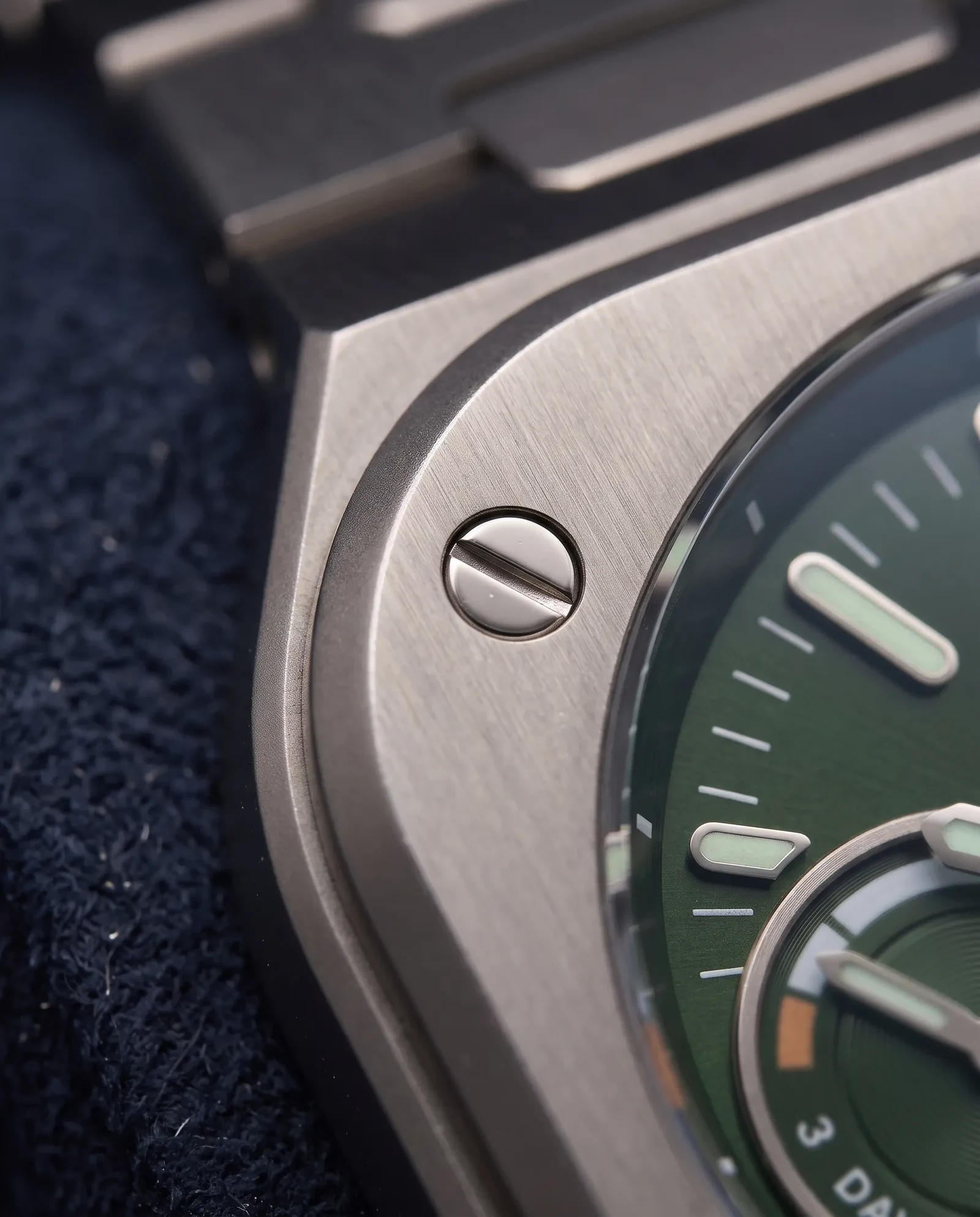
- Case finishing and screw alignment. The four corner screws on a genuine BR 01/BR 03 case are precisely machined and evenly seated. Poorly aligned, visibly different-sized, or crudely finished corner screws are a strong warning sign on a square-cased Bell & Ross specifically, since the square case has nowhere to hide sloppy machining the way a round case might.
- Dial printing and lume quality. Genuine Bell & Ross dials, particularly the sandwich-style luminous dials used on pieces like the Green Lum BR-X5, use precisely cut lume plates rather than printed-on luminous paint. Blurred printing, uneven lume application, or incorrect fonts on the dial text are common tells on fakes.
- Movement and caseback. Where the caseback is closed (as on most BR 03-94 models), a watchmaker can still check movement authenticity via the winding/setting feel and timing accuracy. Open-case or exhibition examples should show a correctly finished, correctly labelled Kenissi or Bell & Ross-stamped movement, not a generic substitute.
- Papers, box and purchase history. A full set with original box, warranty card and purchase documentation isn’t strictly required to own a genuine watch, but its absence removes a layer of verification you’d otherwise have, and should be reflected in the price you’re prepared to pay.
The honest answer, as with any watch in this price bracket, is that the most reliable check is having the piece independently authenticated by someone who handles the brand regularly, rather than relying on visual inspection alone from photographs. We check every watch we buy in through Motion Watches against genuine reference examples before it goes on sale, precisely because visual checks alone aren’t good enough on their own for a considered purchase.
Bell & Ross Pre-Owned Pricing: What to Expect
Bell & Ross doesn’t have the dense secondary-market data that exists for Rolex or Patek Philippe – it’s a smaller brand with a smaller resale market, which cuts both ways. On the one hand, that means pre-owned Bell & Ross pieces have historically been more attainable relative to their original retail price than, say, a Rolex Submariner, which can hold or exceed retail. On the other, it means pricing guidance here is necessarily broader and should be treated as directional rather than exact.
As a rough guide: standard steel BR 03-94 chronograph models on rubber straps have generally traded in the low-to-mid thousands of pounds on the pre-owned market, with limited editions, special materials (carbon, ceramic, PVD finishes) and the newer BR-X5 range commanding meaningfully more, often into five figures for rarer references. Where we quote a specific price on a specific watch in our own stock, that figure reflects the actual condition, completeness and provenance of that individual piece, not a generic brand-level estimate – which is really the only reliable way to price anything in this category.
Buying a Bell & Ross From Motion Watches
We currently have two Bell & Ross pieces in stock: the BR-X5 Green Lum Limited Edition (reference BRX5R-LUM-TC/SRB) and a BR 03-94 Commando chronograph from 2014. Both are genuine, independently checked pieces, sold with the documentation we hold on them and backed by our usual aftercare. Stock on specific Bell & Ross references turns over quickly given how few come onto the pre-owned market at any one time, so if you’re after something specific – a particular reference, case material or dial colour – it’s worth getting in touch so we can let you know when something matching your brief comes in, or source it directly through our watch sourcing service.
If you’re looking to sell or value a Bell & Ross you already own, the same brand and condition factors covered above – movement type, completeness, limited-edition status – drive what it’s realistically worth, and our valuation guide covers how we approach that in more detail, or you can speak to us directly via our contact page.
Is Bell & Ross Worth Considering?
Bell & Ross won’t suit everyone – the square case is a genuine style statement, not a safe, round, blend-in choice, and the brand doesn’t have the universal name recognition of Rolex or the horological prestige of Patek Philippe. What it does offer is a design identity that’s actually distinct rather than a variation on an established theme, a real and well-documented military heritage behind the aesthetic, and – particularly with the BR-X5’s Kenissi-built chronometer movement – genuine engineering credibility at a price point that’s still more accessible than most of its integrated-bracelet-sports-watch rivals. If that combination appeals, it’s a brand worth taking seriously rather than overlooking in favour of the obvious names.