Hublot doesn’t try to look like a century-old Swiss house, because it isn’t one. It’s one of the youngest names in the luxury watch world to have made it into the top tier, and it got there by doing the opposite of what most watchmakers were doing: bolting rubber onto gold, building cases the size of a small clock face, and putting Formula 1 branding on a Swiss chronograph. If you’re thinking about buying a pre-owned Hublot, it helps to understand that this is a brand built on deliberate contrast rather than quiet tradition – and that changes what you should look for, and what you should expect to pay.
The Hublot Story: A Deliberately Modern Watchmaker
Hublot was founded in 1980 by the Italian designer Carlo Crocco, part of the family behind Italy’s Binda Group, who had moved to Switzerland and set up a company called MDM Genève. Crocco named his watch “Hublot” – French for “porthole” – and built it around an idea that sounds obvious now but wasn’t in 1980: pairing a precious-metal case with a natural rubber strap. At the time, rubber had no place anywhere near a gold watch. Hublot’s first collection debuted at the Basel Watch Fair in 1980 and reportedly generated more than $2 million in sales in its first year, which was a serious result for a brand nobody had heard of.
The watch everyone actually recognises today, though, came from the brand’s second era. Jean-Claude Biver, previously of Blancpain and Omega, met Crocco in late 2003 and became Hublot’s CEO in May 2004. Sales were around CHF 24 million when he arrived. In April 2005, Biver unveiled the Big Bang chronograph in Basel as Hublot’s new flagship – a thick, heavily layered, unapologetically oversized sports watch that mixed materials (ceramic, titanium, rubber, ultra-light carbon fibre) in a way no major Swiss brand had done before. Orders are reported to have tripled within a year, and by the end of 2006 Hublot’s sales had grown to close to CHF 100 million. LVMH bought Hublot from Crocco in April 2008, and it has remained a wholly owned LVMH brand ever since, sitting alongside TAG Heuer in the group’s watch division under current CEO Ricardo Guadalupe.
The point of that history for a buyer: Hublot is not trading on heritage the way Patek Philippe or Vacheron Constantin are. It’s trading on a 45-year-old idea executed loudly and consistently – the “Art of Fusion,” as the brand calls it – and that’s exactly why it has such a strong following among people who want a sports watch that doesn’t look like everyone else’s sports watch.
The Core Collections: Big Bang, Classic Fusion and King Power
Three collections do most of the work in Hublot’s current range, and they’re worth knowing apart before you buy.
Big Bang is still the brand’s flagship line and the one most people picture when they hear “Hublot” – a round case, usually 42mm to 45mm depending on the reference, with the brand’s signature H-shaped bezel screws and a mix of case materials that changes constantly across limited runs and special editions.
Classic Fusion is the more restrained side of the brand – thinner cases, a bezel set closer to the case, smaller and more understated screws, and a cleaner dial. It’s the Hublot for someone who wants the brand’s engineering and finishing without the size and visual noise of the Big Bang.
King Power sits above the Big Bang as a deliberately heavier, more industrial evolution of the same architecture – typically a 48mm case built from the same mix of composite resin, ceramic and titanium, with the same six H-shaped titanium screws securing the bezel but scaled up. It’s the collection Hublot tends to use for its boldest material experiments, its most technical complications, and its highest-profile limited editions – including the piece covered below.
Underpinning the brand’s higher-end pieces is Hublot’s in-house UNICO movement family – a column-wheel chronograph movement with a double-clutch system, developed and produced at Hublot’s own manufacture in Nyon (opened in 2009) rather than bought in from a third-party movement maker. On simpler references, Hublot also uses its MECA-10 calibre, recognisable by the rack-and-pinion power reserve display on the dial rather than a conventional hand.
Hublot and Formula 1: Where the King Power Name Gets Its Edge
Hublot’s relationship with motorsport isn’t a marketing afterthought – it’s been part of the brand’s identity for over fifteen years. Jean-Claude Biver announced Hublot’s appointment as Official Timekeeper of Formula 1 on 13 March 2010, at the opening Grand Prix of that season in Bahrain. The partnership brought Hublot-branded timing to race weekends, a Hublot presence in the Paddock Club at Grands Prix, and a steady run of King Power watches finished in the liveries and colours of specific races and teams. Hublot went on to run a parallel, decade-long partnership as Ferrari’s official watch and timekeeper from 2012, and has also been the official watch of multiple FIFA World Cups and, more recently, UEFA competitions – all part of the same strategy of attaching the brand to fast-moving, high-visibility sport rather than quiet horological tradition.
The King Power F1 line sits right at the centre of that story, which is exactly where the piece we currently have in stock comes from.
In Stock Now: Hublot King Power F1™ Tourbillon
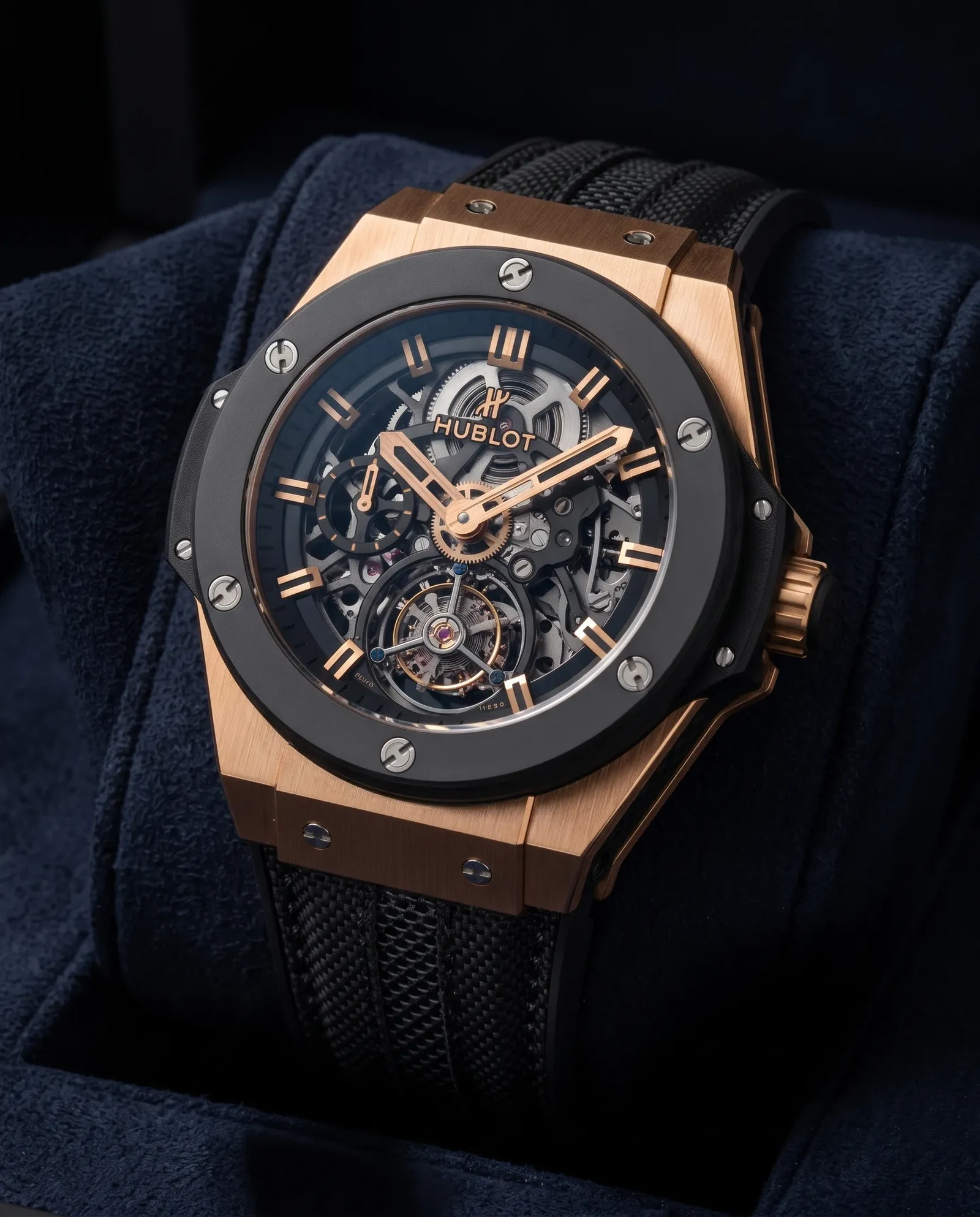
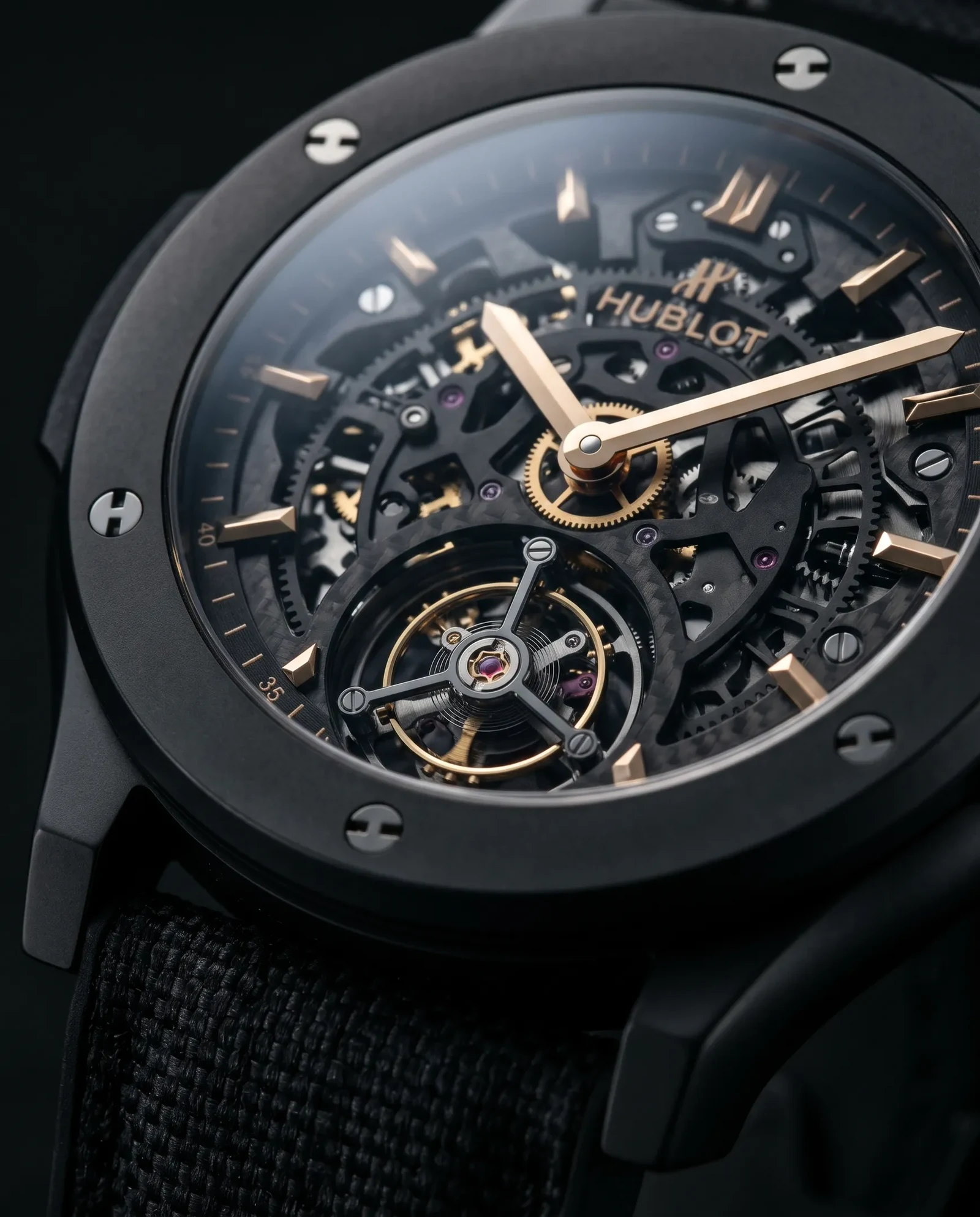
At the time of writing, we have one Hublot in stock: a King Power F1™ Tourbillon (ref. 707.OM.1138.NR.FMO10), one of only 50 made worldwide. It’s a genuinely serious piece – an 18k King Gold case with carbon fibre accents at 48mm, a manual-winding tourbillon movement visible through an open-worked dial, a ceramic bezel with F1-inspired detailing, and a black Nomex strap made from the same fire-resistant material used in racing suits.
In the interest of being straightforward about exactly what you’d be buying: this particular watch is being sold as watch-only. The original box and papers were lost by the previous owner during a house move, so it doesn’t come with its full set. It is supplied with our own branded presentation case, and like every watch we sell, it’s been fully checked for authenticity in-house and comes with our standard 12-month warranty. Missing papers doesn’t affect whether a watch is genuine, but it is something that can matter to a future buyer or insurer, so we think it’s worth being upfront about rather than glossing over it. If a complete set with original box and papers matters more to you than this specific reference, our watch sourcing service can look for a comparable King Power or Big Bang Unico with a full set through our dealer and collector network.
Because this is a one-of-fifty limited edition with a tourbillon movement, it sits well above Hublot’s everyday pricing – more on that below. Get in touch via our contact page if you’d like more detail, further photographs, or to arrange a viewing at our Ipswich showroom.
What to Check Before Buying a Pre-Owned Hublot
Hublot’s bold, highly recognisable silhouette – particularly the Big Bang – is one of the more heavily imitated designs in the luxury watch market, so a proper check before you buy matters as much here as it does with any other brand we sell. None of this replaces an in-person inspection, but it’s a useful starting point:
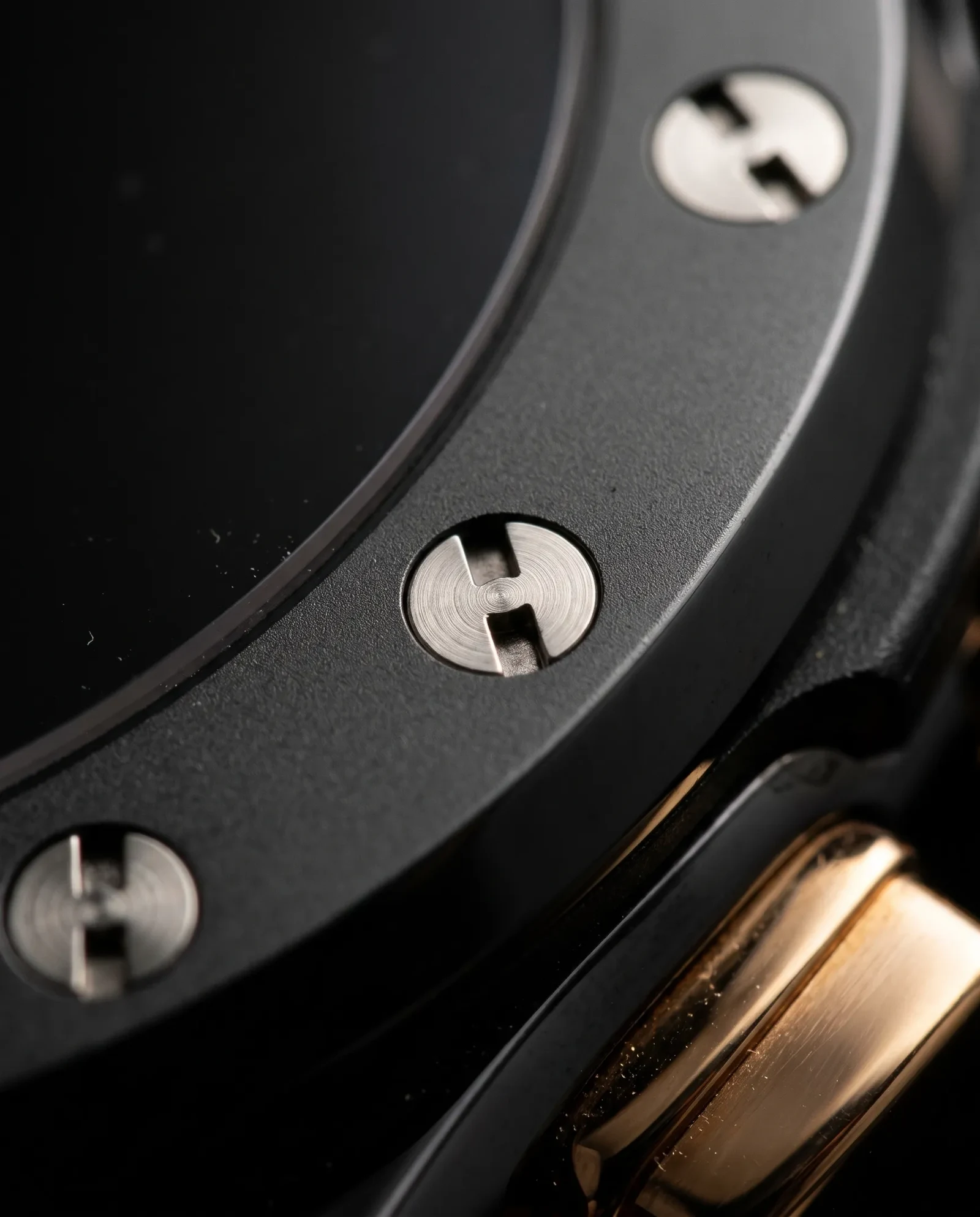
The bezel screws. Every genuine Hublot bezel (Big Bang, King Power and Classic Fusion alike) is secured with six H-shaped titanium screws. On a real watch they’re identically machined, sit flush against the bezel, and are functionally load-bearing rather than decorative. Uneven heights, rough edges, or screws that look more like a generic cross than a clean “H” are a strong warning sign.
Weight and materials. The weight should match the stated case material – titanium feels notably lighter than steel, ceramic lighter again, and King Gold (Hublot’s own gold alloy, slightly warmer and redder than standard rose gold) noticeably heavier than either. Genuine carbon fibre shows a real woven texture, not a printed pattern, and there should be no rattling or play between the bezel and case.
The movement, where visible. On UNICO-powered pieces, look for the column wheel on the dial side; on MECA-10 pieces, the power reserve is shown via a rack-and-pinion mechanism rather than a conventional subdial hand. Rotors and bridges should carry Hublot’s own signature – an unsigned movement is a red flag.
Caseback engraving and reference numbers. Engravings should be crisp and precise, never shallow or inconsistent, and the reference number should follow Hublot’s own numbering conventions for that model. On a limited edition, the production number (for example, a watch marked as number 12 of 50) should fall within the stated run – this is one of the things we check as a matter of course on any limited edition we take in.
The crown and strap system. The “H” logo on the crown should be cleanly formed, the crown material should match the case, and screw-down action should be smooth. Many Hublot straps use the brand’s “One Click” quick-release system – it should click in and out smoothly with no play once attached.
Every watch we sell, Hublot included, is checked for authenticity before it’s listed – that’s part of our 100% Authenticity Guarantee, not something we leave to the buyer to work out after the fact. If you’d like to go further before committing to any watch, independent authentication from a specialist is always a sound extra step, particularly on a high-value piece.
What Does a Hublot Actually Cost?
Hublot doesn’t publish a single global price list the way some brands do, and secondary-market pricing varies a lot by model, material and condition, so treat the following as a directional guide rather than a quote. Fair-market pre-owned pricing on Hublot’s mainstream steel and titanium Big Bang and Classic Fusion references broadly tracks in the £5,000–£12,000 range, depending on complication and condition. Precious-metal King Gold pieces, limited editions, and anything with an in-house complication beyond the standard chronograph (tourbillons, minute repeaters, skeleton movements) sit well above that, often into five figures and beyond – which is exactly the bracket our current King Power F1 Tourbillon sits in, reflecting its 18k King Gold case, tourbillon movement and 1-of-50 rarity. If you’re trying to work out what a specific reference is actually worth, whether you’re buying or selling, our own watch valuation guide covers the factors that genuinely move the number.
Hublot Compared to Other Bold Sports Watches
If you’re choosing between Hublot and another brand in the same “statement sports watch” bracket, the honest comparison is usually with Audemars Piguet’s Royal Oak Offshore or Richard Mille. All three lean into oversized cases and technical materials rather than classical dress-watch restraint. Where Hublot differs is accessibility and price point – a steel Big Bang is genuinely attainable in a way that a Royal Oak Offshore or a Richard Mille generally isn’t, while still offering an in-house chronograph movement and the same level of material experimentation. If you’re weighing up a Richard Mille instead, our guide to buying a pre-owned Richard Mille covers that brand’s very different pricing and rarity profile in detail.
Buying Through Motion Watches
We buy, sell and source pre-owned luxury watches from our showroom in Ipswich, with a nationwide service for buyers who can’t get to us in person and an appointment-based service across London and the wider East Anglia region. Every watch we sell is checked for authenticity before it goes on sale, and we offer finance through Ideal4Finance for anyone who wants to spread the cost of a piece like the King Power F1 Tourbillon above. If you’re after a specific Hublot reference we don’t currently have in stock – a particular Big Bang Unico, a Classic Fusion in a size or material we don’t hold, or a King Power with its original box and papers intact – our watch sourcing service uses our dealer and collector network to track one down. And if you’re thinking about selling a Hublot rather than buying one, our team can give you an honest, no-obligation valuation – get in touch via our contact page to start either conversation.