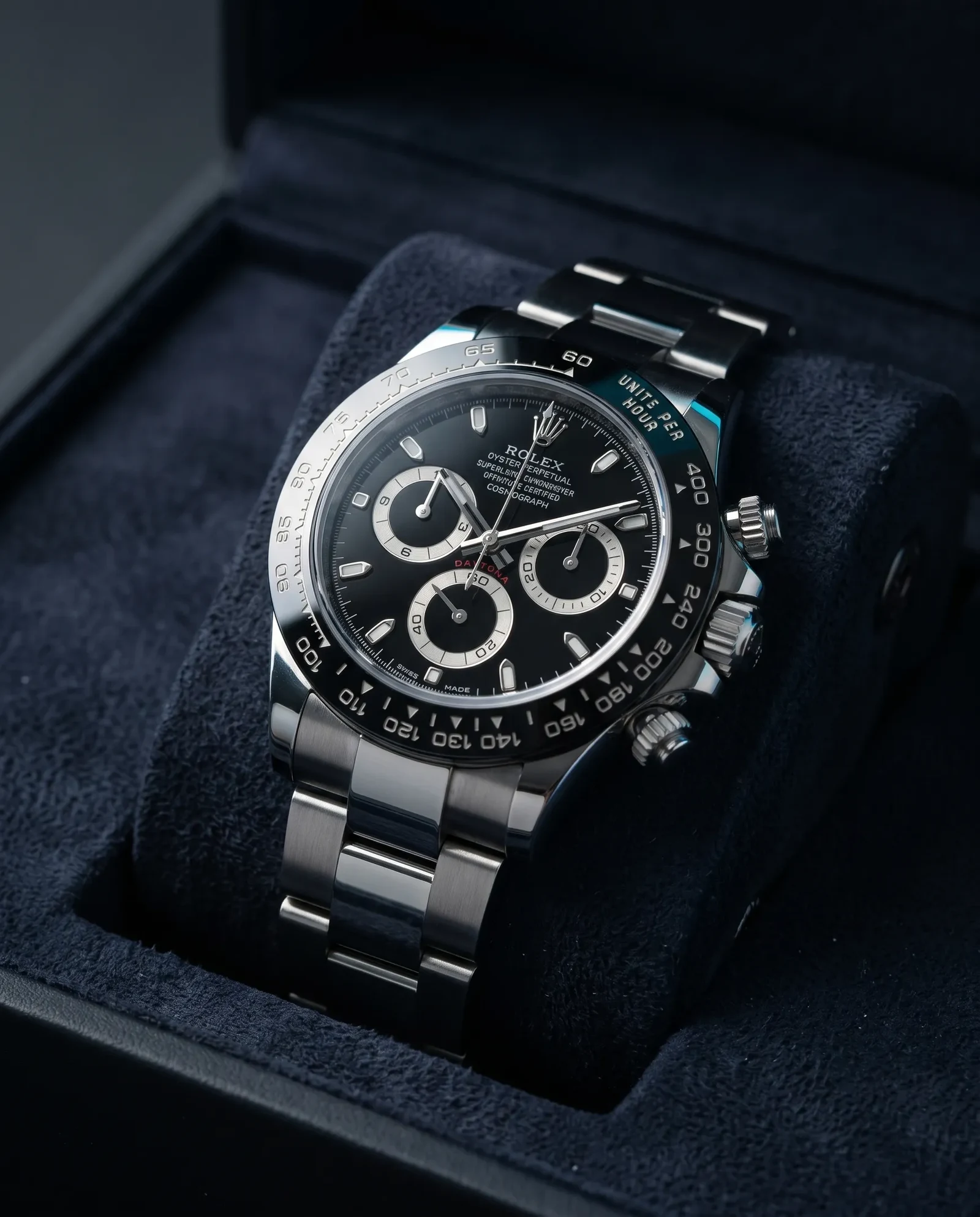
The Rolex Cosmograph Daytona is the watch most people picture when they hear the word “Daytona” – steel or gold, tachymeter bezel, a case built for a racetrack rather than a boardroom. It is also one of the most asked-about watches we handle at Motion Watches, and until now we hadn’t written a dedicated guide to it. This one covers where the Daytona came from, how the watch inside it has changed across six decades, what to check before buying one pre-owned, and which real examples we currently have in stock.
Where the Daytona started
Rolex introduced the Cosmograph in 1963 as reference 6239 – a chronograph with a contrasting two-colour dial and an engraved tachymeter bezel, designed to be read at a glance by a driver rather than studied at a desk. The watch took its name from the Daytona International Speedway in Florida, home to the 24 Hours of Daytona, after Rolex became closely associated with endurance motor racing through the 1960s. For the first few months the dial carried only “Cosmograph” beneath the Rolex signature; “Daytona” was added to the dial shortly afterwards and has stayed there ever since.
The early references (6239, 6240, 6241, 6262, 6263, 6264 and 6265) ran from 1963 until 1988, powered by Calibre 722 and later 727 – both based on a Valjoux manual-wind chronograph movement, wound by hand rather than the rotor on your wrist. Water resistance varied by reference: models with pump-style pushers were rated to 50 metres, while the screw-down-pusher references were rated to 100 metres and carried the Oyster name on the dial as a result.
The “Paul Newman” dial
A small number of these manual-wind Daytonas were fitted with an “exotic” dial made for Rolex by Stern Frères – Art Deco-style numerals on the sub-dials, a stepped minute track, and a noticeably different look from the standard dial of the same reference. They sold poorly when new, which is exactly why so few survive today. The actor Paul Newman owned and wore one, and once collectors began paying serious attention to Rolex history in the 1990s, his name attached itself to the whole exotic-dial family. His own Daytona – reference 6239, a gift from his wife Joanne Woodward – sold at Phillips in October 2017 for $17,752,500, which remains one of the most-cited sales in modern watch collecting. Genuine vintage exotic-dial Daytonas are rare, valuable, and a favourite target for fakes and “improved” dials, which is why we’d always recommend independent authentication before buying one privately rather than relying on a seller’s word.
The automatic era: 1988 to 2000
In 1988 Rolex redesigned the Daytona into reference 16520, its first automatic Daytona, in a larger 40mm case with a sapphire crystal in place of the earlier acrylic. The movement, Calibre 4030, was a heavily modified version of the Zenith El Primero – at the time arguably the first automatic chronograph movement on the market – with Rolex slowing its beat rate from 5Hz to 4Hz (28,800 vibrations per hour) and reworking a large share of its components. Some early 16520 dials, nicknamed “Patrizzi” after the auctioneer who first drew attention to them, have sub-dial surrounds that have oxidised from a varnish issue at the time to a warm brown rather than the original black – a cosmetic quirk that collectors now actively seek out rather than avoid.
Going in-house: Calibre 4130 and the ceramic bezel
Rolex replaced the Zenith-based movement in 2000 with Calibre 4130, its first fully in-house Daytona movement, debuting in reference 116520. It was a genuine re-engineering rather than a refinement: power reserve rose from 54 to 72 hours, the chronograph mechanism moved from two separate modules to one, component count dropped from around 322 to 201, and a vertical clutch replaced the earlier lateral clutch – giving a cleaner, less jumpy start and stop to the chronograph seconds hand. The 116520 stayed in production, essentially unchanged, until 2016.
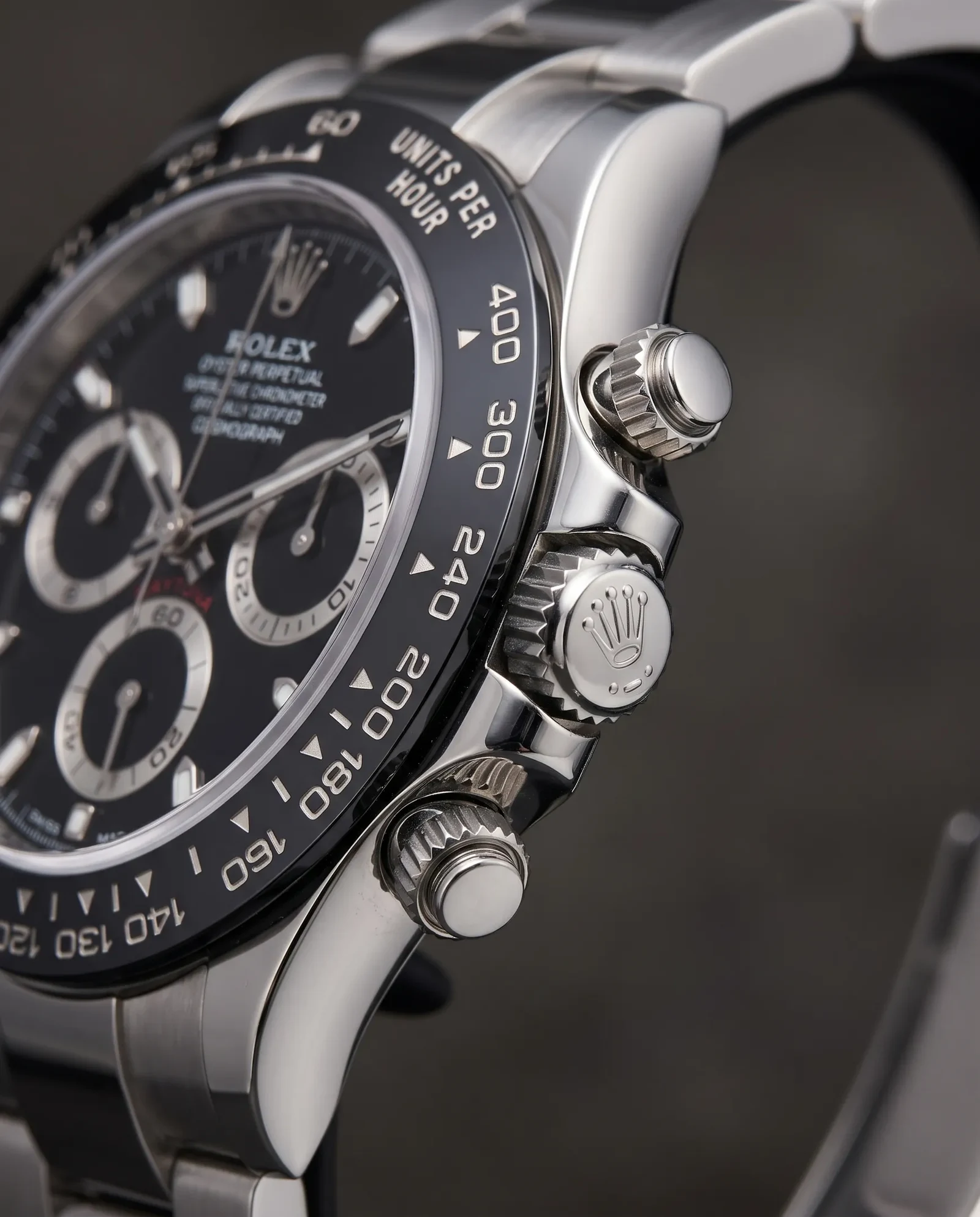
In 2016 Rolex introduced reference 116500LN, still on Calibre 4130, but with a black Cerachrom ceramic bezel in place of the earlier steel one and laser-etched rather than printed markings – a Daytona that is effectively impossible to scratch across the bezel insert the way steel ones eventually do. It is, by most measures, the most recognisable modern Daytona and the reference that drove years of waiting lists at Rolex boutiques.
At Watches and Wonders 2023, marking the Daytona’s 60th anniversary, Rolex updated the range again with reference 126500LN in steel and a parallel set of precious-metal references including 126506 (platinum) and 126508 (yellow gold). These run the updated Calibre 4131, an evolution of the 4130 with a Chronergy escapement and Paraflex shock absorbers, and in some precious-metal references a sapphire case back showing the movement rather than a solid one.
What to check before buying a pre-owned Daytona
A pre-owned Daytona is still a mechanical chronograph with decades of history behind the design, so the usual rules for buying any high-value watch apply, with a few specific to this model:
Dial originality. This matters on every Daytona, but especially on anything described as an exotic or Paul Newman dial. A re-dialled watch can look very convincing; professional authentication, not a seller’s assurance, is the standard to insist on for anything from the manual-wind era.
Service history. Ask for documented servicing rather than taking “runs fine” at face value. A Calibre 4130 or 4131 that has never been serviced isn’t necessarily a problem on its own, but it’s a detail that should be disclosed and priced into any offer, not discovered afterwards.
Case and bezel condition. On steel references, sharp, unpolished case edges are worth more to collectors than a case that’s been over-polished and softened at the lugs. Ceramic-bezel references (116500LN onward) don’t scratch the way steel bezels do, but do check for chips at the edge of the insert.
Box, papers and full sets. A genuine, matching box-and-papers set adds real value on a Daytona specifically, because the model is so heavily counterfeited and because original paperwork helps confirm the watch’s production date against its case and movement details. It isn’t the only thing that matters, but a “naked” watch with no documentation deserves more scrutiny, not less.
Bracelet and clasp. On vintage references, check the bracelet carries end links correctly stamped for that reference rather than a later or generic replacement. On any reference, a stretched or heavily worn bracelet affects both wearability and resale value.
Spotting a fake Daytona
The Daytona is one of the most counterfeited watches Rolex makes, simply because it’s so widely recognised and so widely wanted. The same general checks that apply to any Rolex apply here – weight (a genuine steel Daytona is noticeably heavier than a convincing fake of the same size, because Rolex uses solid 904L steel rather than a lighter alloy), the smoothness of the sweeping seconds hand against a fake’s ticking motion, and the quality of the engraving on the case back and between the lugs – but a few checks are specific to this model. On the 116500LN and 126500LN, the Cerachrom bezel markings should be crisp and slightly raised or recessed depending on the finish, never simply printed flat onto the ceramic. On any in-house reference (116520 onward), the sub-dials should be perfectly flush with the dial surface, and the “Daytona” text should sit in exactly the right typeface and position for that reference – fakes often get the font weight or spacing subtly wrong. Serial numbers on post-2010 references are engraved on the rehaut (the inner bezel edge around the dial, visible through the crystal) rather than between the lugs, and should match the paperwork if present. None of this is a substitute for a proper inspection by someone who handles these watches daily, which is exactly the check every watch goes through before it’s offered for sale here. Our separate guide on how to spot a fake Rolex covers the checks that apply across the whole range in more depth.
Daytona or Speedmaster?
The Daytona is often mentioned in the same breath as Omega’s Speedmaster, and the comparison is a fair one – both are motorsport-linked chronographs from the same era with long, well-documented histories. The practical differences come down to movement philosophy and price. The Speedmaster Professional still ships with a manually wound movement as standard, which some buyers specifically want for the mechanical connection to its original 1960s form, while every Daytona since 1988 has been automatic. The Daytona also sits at a meaningfully higher price point across almost every comparable reference, reflecting Rolex’s production volumes, brand positioning and the sheer weight of demand for steel sports models generally. Neither is the “better” watch in any absolute sense – it depends on what you want from it – and we cover the Speedmaster in detail in our separate guide to buying an Omega Speedmaster.
Running costs: servicing a Daytona
A Daytona is not a watch to buy and then ignore. Rolex recommends a full service roughly every ten years for modern references, though plenty of independent watchmakers would suggest checking in sooner on an older or harder-worn piece. A full service through Rolex’s own service centres typically runs into four figures once a chronograph movement, case refinishing and a genuine parts replacement are factored in, and independent watchmakers specialising in Rolex movements can often do the same work for less, provided they use correct parts and you’re comfortable with the warranty trade-off that comes with going outside the brand’s own network. Either way, factor servicing into the real cost of ownership rather than treating the purchase price as the end of the conversation – it’s a detail we’re always happy to talk through with any pre-owned chronograph, not just a Daytona.
Rolex Daytona: real stock at Motion Watches
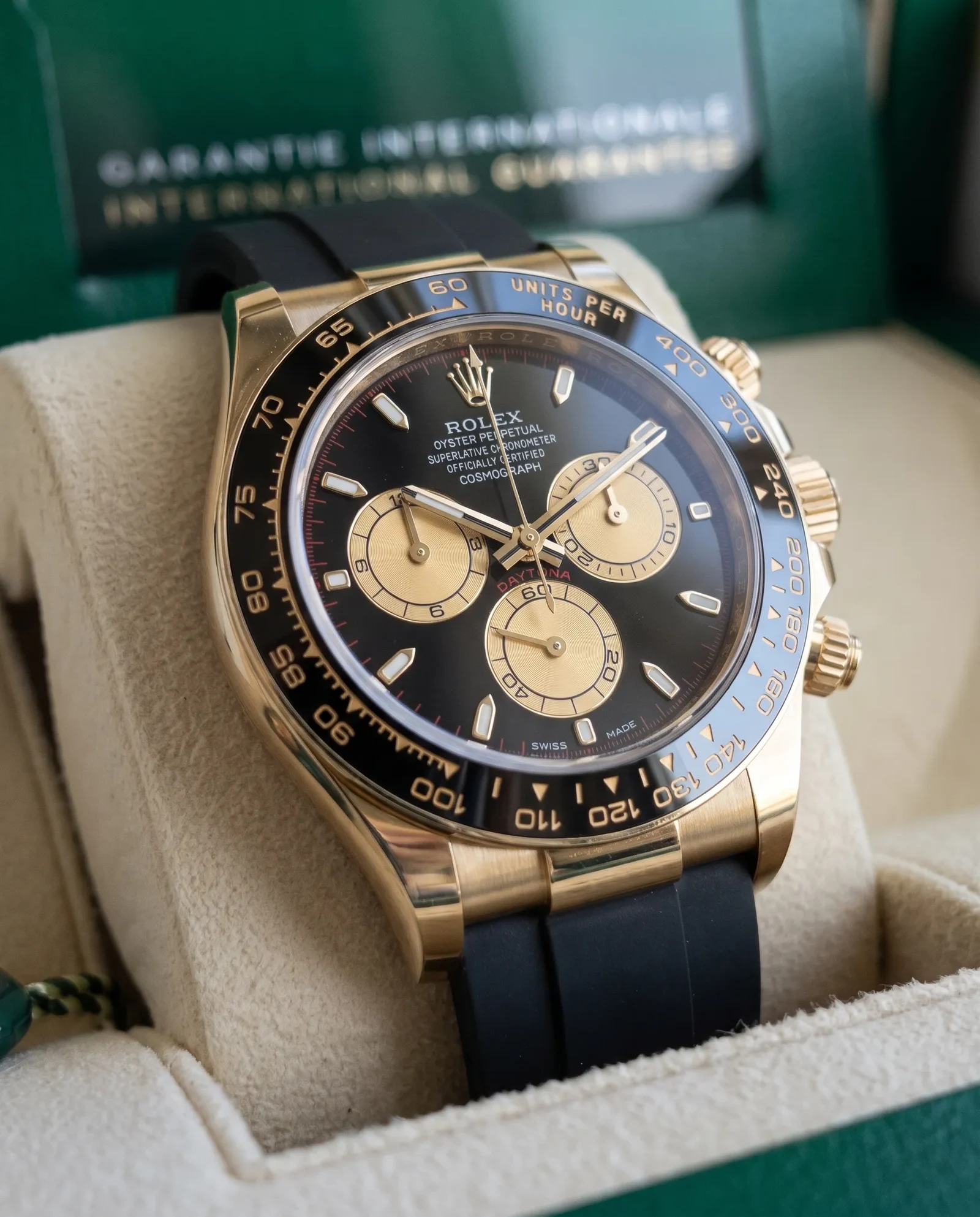
We hold Daytonas across several of these generations at any one time, and like the rest of our stock, availability changes as pieces sell, so treat the following as a snapshot rather than a permanent list. Examples currently in stock include a 2009 reference 116520 in white with the original Calibre 4130 and steel tachymeter bezel, a 2011 116520 in black sold as a complete full set with both boxes and papers, a 2022 “Panda” 116500LN in white with the black Cerachrom bezel, a 2023 116500LN in black, and a 2026 126500LN on the current Calibre 4131. At the top of the range we currently have an 18ct white gold 116509 with a factory pavé diamond dial, an 18ct platinum 126506 with an ice-blue dial, and 18ct yellow gold 126508 references including one with a dial styled after the original exotic “Paul Newman” layout – worth noting that this is a modern piece built in that dial style, not a vintage 1960s exotic-dial watch, and we’d always describe it that way rather than let the nickname imply otherwise.
If a specific reference, dial colour or bracelet isn’t currently in stock, our watch sourcing service can look for it through our dealer and collector network rather than leaving you to wait on a boutique list.
Is a Daytona a good investment?
We’d rather be honest about this than promise something we can’t stand behind. The steel 116500LN went through a period of genuinely extraordinary secondary-market demand between 2016 and roughly 2022, with prices well above retail and waiting lists stretching into years at Rolex boutiques. Since then the broader steel-sports-Rolex market, Daytona included, has corrected from those highs and settled into a more measured trading range. That doesn’t make the Daytona a bad watch to own – it remains one of the most recognisable and consistently in-demand references Rolex makes – but anyone buying one purely as a short-term flip, rather than a watch they’d be glad to wear, is making a bet on a market that has already shown it can move sharply in both directions. Precious-metal and gem-set Daytona references sit on a different footing again, priced more on the gold or platinum content and rarity than on sports-watch demand, and we’d treat them as a different kind of purchase from a steel reference entirely. For a broader look at how Rolex values have moved, see our guide on whether Rolex watches are a good investment.
Buying your Daytona from Motion Watches
Every watch we sell is independently checked for authenticity before it goes on sale, and we’re always upfront about condition, service history and exactly what’s included in the box, rather than leaving that for you to discover later. If you’d like to see our current Daytona stock in person, our showroom in Ipswich is open Monday to Friday, and we see clients from London and across East Anglia by appointment. You can also get in touch via our contact page with any questions about a specific reference, or if you’re thinking about selling a Daytona of your own, our valuation guide explains how that process works.